xicalcoliuhqui (TK217r)
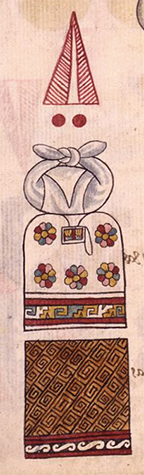
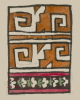
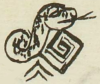
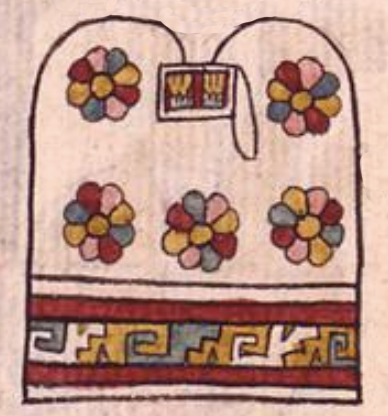
This painted example of iconography refers to a particular design (xicalcoliuhqui, often called step fret or stepped fret) along the bottom of this hand-made blouse that is still called a huipilli today. This special design is especially prevalent on one of the classic Mexica war shields. In the Florentine Codex it also appears on women’s clothing. Intersections of the text, subtext, and context of artistic designs carried or worn by men (shields) and by women (textiles) are worth pursuing further. The rectangular swirl also appears in a number of Nahuatl hieroglyphs that feature water.
Stephanie Wood
The huipil that bears the xicalcoliuhqui design also has a flowery pattern, a rectangular patch (perhaps a pechero) at the lower end of the V-neck, and this patch has some type of textile hanging off of one side. This is a feature of Mesoamerican blouses that lives on in some communities.
Side Note: The folio numbers are not always clear in the copy published online by the British Museum. Marc Thouvenot gives this page the number K15_A in his TLACHIA digital collection, https://tlachia.iib.unam.mx/tepetlaoztoc/K15_A.
Stephanie Wood
c. 1556
Jeff Haskett-Wood
huipil, blusa, camisa, mujer, diseños, género, escudo
xicalcoliuhqui, a stepped fret design, https://nahuatl.wired-humanities.org/content/xicalcoliuhqui
(nombre de un diseño para escudos de hombres y ropa de mujeres)
Stephanie Wood
The Codex Kingsborough, also known as the Códice de Tepetlaoztoc, and the Memorial de los indios de Tepetlaoztoc, is not on display. It was transferred from the British Library and is now held by the British Museum. It is shared on line at: https://www.britishmuseum.org/collection/object/E_Am2006-Drg-13964
©The Trustees of the British Museum. Shared under a Creative Commons Attribution-Non-Commercial-ShareAlike 4.0 International (CC BY-NC-SA 4.0) license. Please also cite the <em>Visual Lexicon of Aztec Hieroglyphsem>, ed. Stephanie Wood (Eugene, Ore.: Wired Humanities Projects, 2020-present) and this URL.