xiuhtomolli (FCbk11f178v)
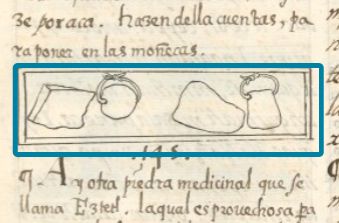
This iconographic example features a black-line drawing of two turquoise-blue or green stones (xiuhtomolli, also called xiuhtomoltetl). They are included in this digital collection for the purpose of making comparisons with related hieroglyphs. The term selected for this example comes from the text near the image in the Digital Florentine Codex. There is no gloss, per se. This example shows, on the left, a rough wedge of turquoise stone. On the right is a round bead with a string tied through the hole and knotted on top. Some sources say that the xiuhtomolli was flat on one side and rounded on the other, but this is not obvious from the bead on the string here. The nearby Nahuatl text speaks of ways the greenstone or turquoise can be incorporated into a remedy, saying it “tastes good” and it can be made into a bracelet that is good for health. The text adds that this xiuhtomolli comes from Guatemala (Cuauhtemallan) and Soconusco (Xoconochco), which suggests it was more likely a precious greenstone (chalchihuitl) and not turquoise (even though some turquoise is green).
Stephanie Wood
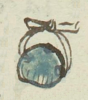
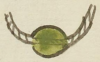
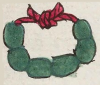
In this digital collection, one can perform an Advanced Search for records where the head word starts with xiuh-. The results will show that such things have been painted either turquoise blue or green, evidence that Nahuas did not make a clear differentiation between blue and green. The search results will also show that turquoise is regularly depicted as small pieces that were used in mosaics, whereas precious greenstones were more likely round beads.
Stephanie Wood
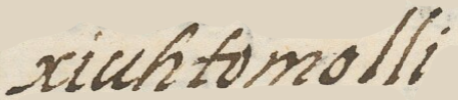
xiuhtomolli
Stephanie Wood
1577
Jeff Haskett-Wood
turquesas, jades, piedra, piedras, pulsera, pulseras, remedios, salud, medicina, medicinas, atado
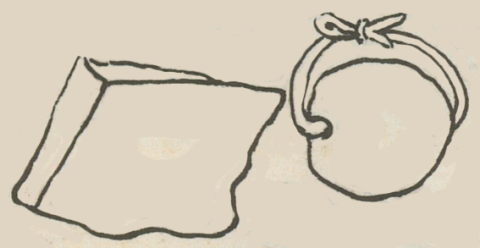
xiuhtomol(li), a turquoise-blue or green stone, https://nahuatl.wired-humanities.org/content/xiuhtomolli
la turquesa, o el jade cultural
Stephanie Wood
Available at Digital Florentine Codex/Códice Florentino Digital, edited by Kim N. Richter and Alicia Maria Houtrouw, "Book 11: Earthly Things", fol. 178v, Getty Research Institute, 2023. https://florentinecodex.getty.edu/en/book/11/folio/178v/images/0 Accessed 16 November 2025.
Images of the digitized Florentine Codex are made available under the following Creative Commons license: CC BY-NC-ND (Attribution-NonCommercial-NoDerivs 4.0 International). For print-publication quality photos, please contact the Biblioteca Medicea Laurenziana ([email protected]). The Library of Congress has also published this manuscript, using the images of the World Digital Library copy. “The Library of Congress is unaware of any copyright or other restrictions in the World Digital Library Collection. Absent any such restrictions, these materials are free to use and reuse.”