Xolo (Verg42v)
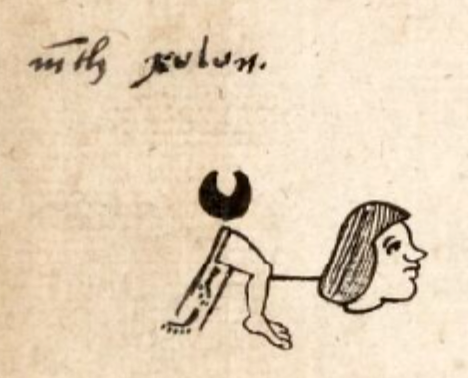
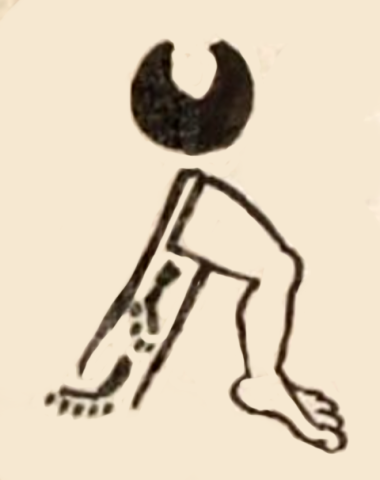
This black-line drawing of the divine force-leader-ancestor called Xolo (“Servant” or “Enslaved Person”), is attested here as a man’s name. It is written entirely in phonetic syllables. The first phonetic syllable would be the foot on the leg, indicating Xo-, the start to the name. If semantic, the -xo- syllable would otherwise have a meaning a lot like “ped” from pedestrian. The second phonetic syllable is -ol- from olli (rubber), shown as a rubber ball with a piece missing at the top. The piece may be missing in order to distinguish the ball from a black bean, which would provide a very different syllable (-e-). Finally, the third phonetic syllable is -o, from the parallel lines containing footprints that represent otli, road. The footprints alternate right and left as they descend, creating a sense of movement.
Stephanie Wood
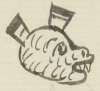
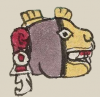
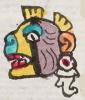
The name Xolo can be confused with Xolotl, a divine force, Chichimec leader/ancestor, and even a hairless dog (short for xoloitzcuintli). The standard iconography for Xolotl will include wrinkles (from xoloctic, wrinkled), or something about the dog, or a combination of the two, such as wrinkled dog head. Sometimes black lines of face paint or tattoos appear on the face, and sometimes the dog has a multicolored head and earrings. If this name is intentionally disguised with the phonography, then perhaps the person is really meant to be Xolotl. Otherwise, it would seem as though the tlacuilo was draw a servant.
Stephanie Wood
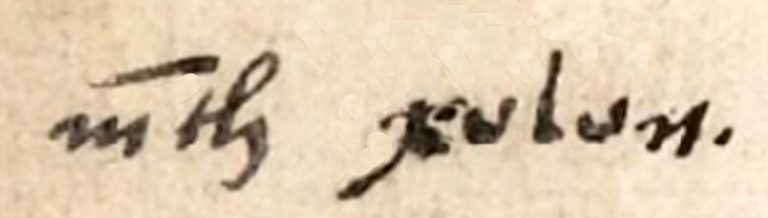
mth xolon
Mateo Xolo
Stephanie Wood
1539
Jeff Haskett-Wood
ancestro, líder, Chichimecas, migración, movimiento, camino, caminos, huellas, hule, pelota, pelotas, pie, pierna, piernas, nombres de hombres, men’s name, fonetismo

Mount Pisgah park, Eugene, Oregon. Photo by Stephanie Wood, 17 May 2026.
Xolotl, divine force and/or Chichimec ancestor-ruler, https://nahuatl.wired-humanities.org/content/Xolotl
xo, having to do with the foot, something like “ped,” https://nahuatl.wired-humanities.org/content/xo
ol(li), rubber, https://nahuatl.wired-humanities.org/content/olli
o(tli), a road, https://nahuatl.wired-humanities.org/content/otli
Xolotl, líder de los chichimecas en el siglo XIII
Stephanie Wood
Available at Codex Vergara, folio 42v, https://gallica.bnf.fr/ark:/12148/btv1b84528032/f92.item.zoom, accessed 14 March 2026. The Vergara is associated with Tepetlaoztoc, in the larger region of Tetzcoco, c. 1539–1543. “Source gallica.bnf.fr / BnF.” We would also appreciate a citation to the Visual Lexicon of Aztec Hieroglyphs, https://aztecglyphs.wired-humanities.org/.
Image Rights: The non-commercial reuse of images from the Bibliothèque nationale de France is free as long as the user is in compliance with the legislation in force and provides the citation: “Source gallica.bnf.fr / Bibliothèque nationale de France” or “Source gallica.bnf.fr / BnF.” We would also appreciate a citation to the Visual Lexicon of Aztec Hieroglyphs, https://aztecglyphs.wired-humanities.org/