Xolo (Verg49v)
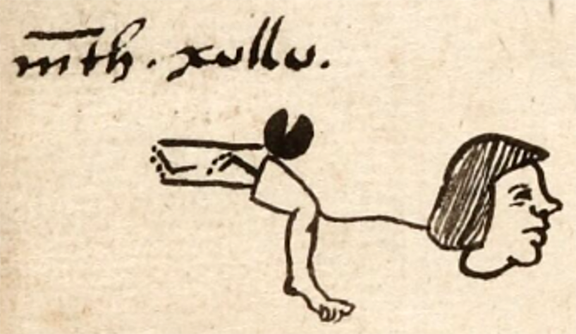
This compound Nahuatl hieroglyph is a black-line drawing of the personal name Xolo (“Servant” or “Enslaved Person”), attested as a man’s name. The compound has three parts. I might start with the leg and foot, a phonetic syllable and the start of this name, Xo-. Above that is the partial rubber ball (olli), which supplies another phonetic syllable, -ol-, which is the middle part of the name, overlapping slightly with the Xo-. Finally, moving to the left is the sign for road (otli), the phonetic syllable -o-, which comes at the end of the name.
Stephanie Wood
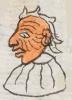
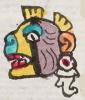
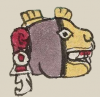
This fully phonographic name is not at all unusual for the Codex Vergara. But dog heads are more commonly found to represent xolo or xolotl in the Matrícula de Huexotzinco. The Codex Mendoza, however, shows xolotl to be a divine force with dog characteristics and xolo to be a servant who would wear a certain type of shirt. See below.
Stephanie Wood
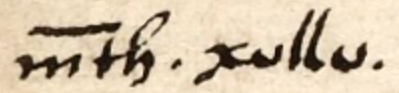
mth. xollo.
Mateo Xolo
Stephanie Wood
1539
Jeff Haskett-Wood
hule, camino, caminos, huella, huellas, pierna, pie, pies, piernas, anatomía, nombres de hombres, men’s names, fonetismo
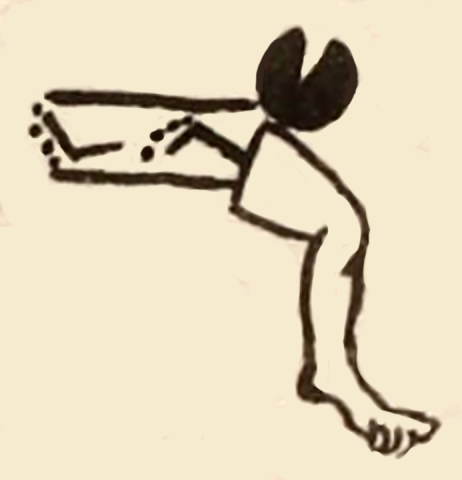
xolo, servant, enslaved person, also penis, https://nahuatl.wired-humanities.org/content/Xolotl
probablemente, Serviente o Persona Esclavizada
Stephanie Wood
Available at Codex Vergara, folio 49v, https://gallica.bnf.fr/ark:/12148/btv1b84528032/f106.item.zoom, accessed 25 March 2026. The Vergara is associated with Tepetlaoztoc, in the larger region of Tetzcoco, c. 1539–1543. “Source gallica.bnf.fr / BnF.” We would also appreciate a citation to the Visual Lexicon of Aztec Hieroglyphs, https://aztecglyphs.wired-humanities.org/.
Image Rights: The non-commercial reuse of images from the Bibliothèque nationale de France is free as long as the user is in compliance with the legislation in force and provides the citation: “Source gallica.bnf.fr / Bibliothèque nationale de France” or “Source gallica.bnf.fr / BnF.” We would also appreciate a citation to the Visual Lexicon of Aztec Hieroglyphs, https://aztecglyphs.wired-humanities.org/