corte (Osu6r)
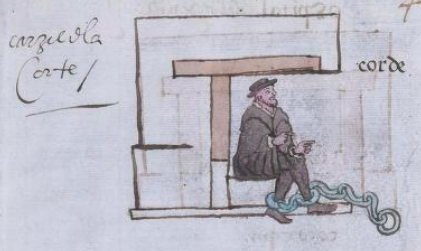
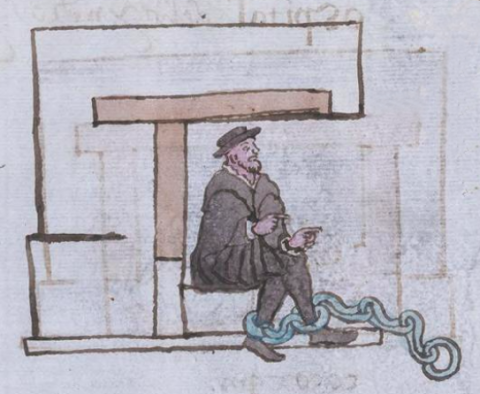
This drawing of the jail of the colonial court (corte, taken into Nahuatl from Spanish) is provided here as an iconographic example, even while the subject is glyph-like. It comes from the Codex Osuna, folio 6 recto (or image 14). It shows a Spanish authority sitting inside a building (a typical calli-type building) in profile, facing toward the viewer’s right. The building is white with a brown T-shaped entrance. The person inside the jail has a full set of dark brown clothing, a hat, a beard, and he gestures with both index fingers. Unlike many similar figures, this man does not have a speech scroll emanating from his mouth; presumably, being imprisoned has meant the loss of his voice and therefore some of his authority. A turquoise-blue chain of six or seven links partly around his ankles presumably limit his mobility, and he is not sitting on the throne-like curule chair that others enjoy. The turquoise color of the chain adds a value that calls out for further investigation.
Stephanie Wood
Incluimos en nuestra colección este dibujo de la prisión de un tribunal colonial (corte, un préstamo del español) como un ejemplo iconográfico, aunque la imagen tiene la apariencia de un glifo. Proviene del anverso del folio 6 del Códice Osuna (imagen 14) y nos muestra a una autoridad española de perfil, que mira hacia la derecha del espectador y está sentada dentro de un edificio, el cual tiene la forma clásica de un calli y es de color blanco con una entrada marrón en forma de t mayúscula. La persona barbuda y ensombrerada en la cárcel está vestida con un juego completo de ropajes de color marrón oscuro y hace un gesto con los índices de ambas manos. El hombre no cuenta con una voluta de la palabra frente a la boca, mientras que muchas figuras similares sí que la tienen: esto quizá signifique que al caer en prisión perdió la voz y por ende parte de su autoridad. Una cadena de color azul turquesa de seis o siete eslabones que se enrosca parcialmente alrededor de sus tobillos quizá limite sus movimientos, además de que no se sienta en la silla curul parecida a un trono de la que otras autoridades disfrutan. El color turquesa de la cadena es un elemento que debería investigarse más a fondo.
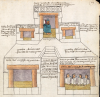
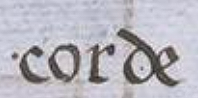
The Nahuatl gloss says “corde,” with a different orthography from the Spanish gloss, which says “carzel de la Corte” (jail of the Court). A similar chain to this one appears in this collection as Tepozmeca (literally, “Metal Cord”), the personal name of an Indigenous man. Also appearing in this collection is the court of Motecuhzoma, which has a similar architecture to this court. See below.
Stephanie Wood
La glosa náhuatl reza “corde”, con una ortografía ligeramente diferente a la de la glosa española, la cual reza “carzel de la Corte”. Una cadena similar a la de este ejemplo aparece también en nuestra colección como Tepozmeca (“Cordel Metálico”), el nombre propio de un indígena. La corte de Motecuhzoma también aparece en nuestra colección y tiene una arquitectura similar a la de este ejemplo: véase más abajo.
corde
corte
Stephanie Wood
1551–1565
Jeff Haskett-Wood
cárcel, cárceles, ilpia, cadenas, oficiales coloniales, cortes, mapilhuia, finger pointing
corte, the court (a Spanish loanword taken into Nahuatl), https://nahuatl.wired-humanities.org/content/corte
la corte
Stephanie Wood
Library of Congress Online Catalog and the World Digital Library, Osuna Codex, or Painting of the Governor, Mayors, and Rulers of Mexico (Pintura del Gobernador, Alcaldes y Regidores de México), https://www.loc.gov/resource/gdcwdl.wdl_07324/. The original is located in the Biblioteca Nacional de España.
"The Library of Congress is unaware of any copyright or other restrictions in the World Digital Library Collection. Absent any such restrictions, these materials are free to use and reuse." But please cite the Biblioteca Nacional de España and this Visual Lexicon of Aztec Hieroglyphs if you use any of these images here or refer to the content on this page, providing the URL.