Xoctepi (MH895v)
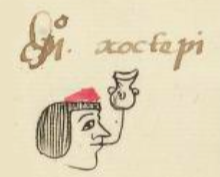
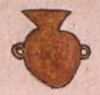
This black-line drawing of the compound glyph for the personal name Xoctepi (or Xoctepih, perhaps “Little Jug”) is attested here as a woman’s name. The glyph shows a small (-tepiton or -tepito) ceramic jug or pitcher (xoctli). The diminutive may be a phonetic indicator for -tepi, which can be a name for an older sister or a servant. It is also interesting how the -tepiton suffix can be shortened to -em>-tepito or even -tepi. See the Tlaltepi glyph, below. Perhaps the -xoc part of the name here refers metaphorically to a rounded belly. If so, then this compound, if we can call it that, could be fully phonetic.
Stephanie Wood
See other Xoctepi name glyphs, below. They are all quite similar.
Stephanie Wood
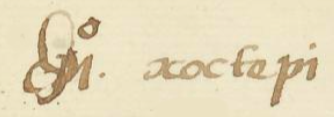
dio. xoctepi
Diego Xoctepi
Stephanie Wood
1560
Jeff Haskett-Wood
pots, pitchers, small, pequeñas, pequeños, cerámica, hermana mayor, nombres de hombres, earthenware, ceramic, ceramics, cerámicas, jug, pot, olla, jarra, jarro, vessel, vessels, vasija de cerámica, cántaro, cántaros, xoctli, xoctepi, huicolli, atlacuihuani, tecomitl, tecontontli, apilolli

xoc(tli), jug, jar, pot, vessel, https://nahuatl.wired-humanities.org/content/xoctli
-tepiton, small, a little bit, https://nahuatl.wired-humanities.org/content/tepiton
-tepi, small or little, https://nahuatl.wired-humanities.org/content/tepi
Olla Pequeña
Stephanie Wood
Matrícula de Huexotzinco, folio 895v, World Digital Library, https://www.loc.gov/resource/gdcwdl.wdl_15282/?sp=863&st=image.
This manuscript is hosted by the Library of Congress and the World Digital Library; used here with the Creative Commons, “Attribution-NonCommercial-ShareAlike 3.0 License” (CC-BY-NC-SAq 3.0).