nopalli (FCbk11f125v)
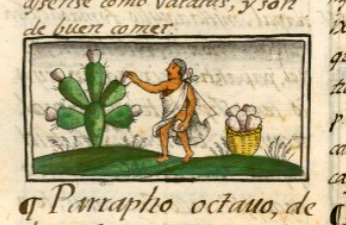
This iconographic example, featuring a prickly pear cactus (nopalli, or nohpalli, with the glottal stop), is included in this digital collection for the purpose of making comparisons with related hieroglyphs. The term selected for this example comes from the text near the image in the Digital Florentine Codex. There is no gloss, per se. This example shows a frontal view of a prickly pear cactus with a central piece and five panels coming off of it. Each of the five panels has one white piece of fruit (nochtli) at the end. A Nahua man wearing a loincloth and having a cloak tied on his left shoulder stands at the cactus, picking the fruit with his right hand and holding a piece of fruit in his left hand. A basket nearby is full of the fruits surely destined for sale in the tianquiztli (market). This entire scene is set in a landscape setting, which, along with the shading that provides a three-dimensionality to the scene, reveals European artistic influences.
Stephanie Wood
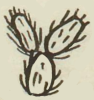
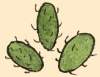
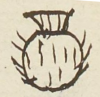
The nochtli is by far the more common feature of the prickly pear cactus that appears in this digital collection, leaving the word nopalli to be fairly rare. Part of the reason for this is the use of the prickly pear fruit in place names, such as Tenochtitlan. Even glyphs of Tenochtitlan will show the whole nopalli plant. Nahuatl hieroglyphs for the popular personal name Nochhuetl show only the nochtli, as do glyphs for Nochco and Nochtepec. There is one personal name Nopal in this collection, and the loose panels (pencas, in Spanish) that would be sold in the market and cleaned of their spines to be cut up for food can be found in the Florentine Codex. What are called “nopales” and eaten today as part of Mexican cuisine are these cut-up panels. The fruit (nochtli, in Nahuatl, and tuna in Spanish) are peeled and eaten like fresho fruit.
Stephanie Wood
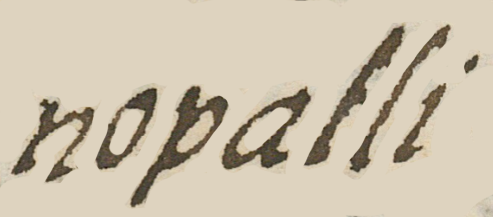
nopalli
Stephanie Wood
1577
Jeff Haskett-Wood
nopales, tuna, tunas, fruta, tianquiztli
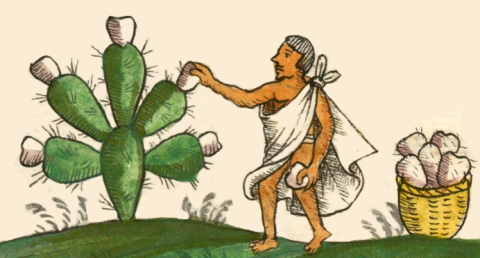
nopal(li), prickly pear cactus, https://nahuatl.wired-humanities.org/content/nopalli
el nopal
Stephanie Wood
Available at Digital Florentine Codex/Códice Florentino Digital, edited by Kim N. Richter and Alicia Maria Houtrouw, "Book 11: Earthly Things", fol. 125v, Getty Research Institute, 2023. https://florentinecodex.getty.edu/en/book/11/folio/125v/images/0 Accessed 16 October 2025.
Images of the digitized Florentine Codex are made available under the following Creative Commons license: CC BY-NC-ND (Attribution-NonCommercial-NoDerivs 4.0 International). For print-publication quality photos, please contact the Biblioteca Medicea Laurenziana ([email protected]). The Library of Congress has also published this manuscript, using the images of the World Digital Library copy. “The Library of Congress is unaware of any copyright or other restrictions in the World Digital Library Collection. Absent any such restrictions, these materials are free to use and reuse.”