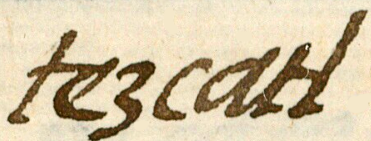
tezcatl (FCbk11f210r)
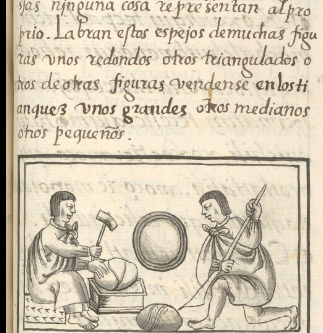
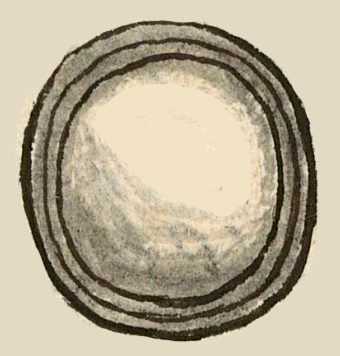
This iconographic example, featuring a black-line drawing of a mirror (tezcatl), is included in this digital collection for the purpose of making comparisons with related hieroglyphs. The term selected for this example comes from the text near the image in the Digital Florentine Codex. There is no gloss, per se. This example shows a round mirror with a reflective center and two gray rings around the center, drawn with black lines. The mirror also has some shading at the bottom, which gives it a three-dimensionality (owing to European artistic influence). The contextualizing image shows two men working stones that are made into mirrors. One has a huictli, with which he presumably dug up his stone. The other has a stone hammer that he is using on his stone. The nearby text refers to many different kinds of mirrors (tecpiltezcatl and tlatocatezcatl, named for the nobles and the ruler, showing how mirrors could be socially calibrated) and says the white mirror is the best. The black mirror was not considered good for looking at one’s face. The text also mentions how these stone mirrors were polished with sand and glued with bat excrement.
Stephanie Wood
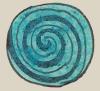
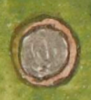
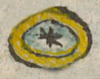
Quite a few mirror hieroglyphs appear in this collection, often as elements of compounds for personal names and place names. In some of the earliest ones, small circles appear on the four “corners” of the circle, perhaps indicating shimmer. They regularly have a ring around the edge of the circle, whether red, white, and (rarer) yellow or brown. One has a turquoise-blue center with what may be a star in the middle, suggesting a conceptual association between mirrors and skies. See a few examples below.
Stephanie Wood
tezcatl
Stephanie Wood
1577
Jeff Haskett-Wood
espejos, piedras, pulir, pulido, pulidos, arena, excremento de murciélago, cielo, estrellas
tezca(tl), a mirror, https://nahuatl.wired-humanities.org/content/mirror
el espejo (de piedra)
Stephanie Wood
Available at Digital Florentine Codex/Códice Florentino Digital, edited by Kim N. Richter and Alicia Maria Houtrouw, "Book 11: Earthly Things", fol. 210r, Getty Research Institute, 2023. https://florentinecodex.getty.edu/en/book/11/folio/210r/images/0 Accessed 16 November 2025.
Images of the digitized Florentine Codex are made available under the following Creative Commons license: CC BY-NC-ND (Attribution-NonCommercial-NoDerivs 4.0 International). For print-publication quality photos, please contact the Biblioteca Medicea Laurenziana ([email protected]). The Library of Congress has also published this manuscript, using the images of the World Digital Library copy. “The Library of Congress is unaware of any copyright or other restrictions in the World Digital Library Collection. Absent any such restrictions, these materials are free to use and reuse.”