tepetl (FCbk11f232r)
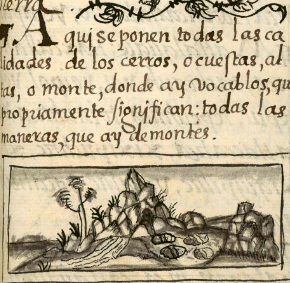
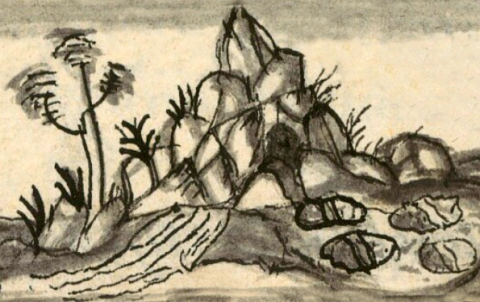
This iconographic example, featuring a black-line sketch of a mountain (tepetl), is included in this digital collection for the purpose of making comparisons with related hieroglyphs. The term selected for this example comes from the text near the image in the Digital Florentine Codex. There is no gloss, per se. This example shows a rocky mountain with a notable peak, some plant life here and there (said, in the text, to be herbs and shrubs), and a tree to the left. The contextualizing image shows another smaller rocky hill on the right of the mountain. Water flows out of the bottom of the mountain and goes somewhat to the left. To the right of the mountain, on the top of the ground are four stones drawn in a roughly hieroglyphic way: horizontal oval shapes with a diagonal band across their middles.
Stephanie Wood
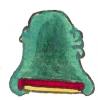
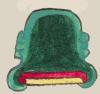
This sketch or black-and-white painting is quite different from the a painting of an original hieroglyph (see below), but there are echoes from the past. It is narrower at the top than at the bottom. The mountain is rocky, like the curly edges of the original glyphs, but these stones are more representative than stylistic. Still, there are four stones on the land below the mountain that are hieroglyphs. A spring emerges from the bottom, coming somewhat toward the viewer (although it also goes to the left). Most early tepetl glyphs have horizontal slits (if colored, in red and yellow) at the bottom where spring water would emerge. But occasionally, a tepetl will show spring water emerging, such as in the Colhuacan glyph from the Relación Geográfica and the Ixicayan glyph (below). At least one glyph for Chapultepec shows a spring emerging and turning right.
Stephanie Wood

Tepetl
tepetl
Stephanie Wood
1577
Jeff Haskett-Wood
mountains, montañas, cerros, piedras, rocas, picos, aguas, manantial, manantiales, springs, tree, trees, árbol, árboles
tepe(tl), hill or mountain, https://nahuatl.wired-humanities.org/content/tepetl
te(tl), stone or rock, https://nahuatl.wired-humanities.org/content/tetl
la montaña, o el cerro
Stephanie Wood
Available at Digital Florentine Codex/Códice Florentino Digital, edited by Kim N. Richter and Alicia Maria Houtrouw, "Book 11: Earthly Things", fol. XXX, Getty Research Institute, 2023. https://florentinecodex.getty.edu/en/book/11/folio/XXX/images/0 Accessed 16 November 2025.
Images of the digitized Florentine Codex are made available under the following Creative Commons license: CC BY-NC-ND (Attribution-NonCommercial-NoDerivs 4.0 International). For print-publication quality photos, please contact the Biblioteca Medicea Laurenziana ([email protected]). The Library of Congress has also published this manuscript, using the images of the World Digital Library copy. “The Library of Congress is unaware of any copyright or other restrictions in the World Digital Library Collection. Absent any such restrictions, these materials are free to use and reuse.”