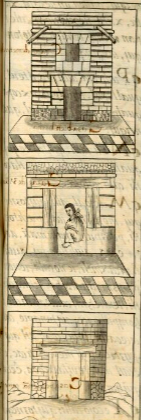
tlapancalli (FCbk11f242r)
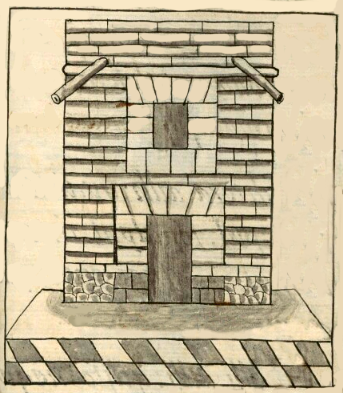
This iconographic example, featuring a black and white sketch of a house with a terrace (tlapancalli), is included in this digital collection for the purpose of making comparisons with related hieroglyphs. The term selected for this example comes from the text near the image in the Digital Florentine Codex. There is no gloss, per se. This example shows what appears to be a tall house, possibly two stories, given the window above the front door. Added to that is perhaps a terrace with a half wall on the roof. Diagonal support beams on right and left seem to support the added structure on the roof. These beams are round and protrude. The building has dark and light alternating paving stones in front, along with a small, smooth patio for accessing the front door. The door may be open; if so, the interior is dark. This is true, too, of the window. The companion text refers to this house as open and cold, which could be a reference to these openings or a comment on the rooftop terrace. The door and window appear to be reinforced with stones surrounding their openings. The facade of the house appears to be covered with adobe bricks or rectangular stones, but the explanatory text refers to a wooden covering. At the very base there appears to be some mosaic of smaller stones. Shading in front of the house and inside the openings adds a three-dimensionality to the sketch, something probably learned from colonial art teachers.
Stephanie Wood
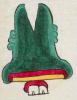
While this database has no hieroglyphic examples of tlapancalli as of July 2026, it does include hieroglyphs that provide visual expressions of the element -tlapan- as it seems to refer to something split. Perhaps the tlapancalli was conceived of as a building divided into two. A two-story house, however, had its own term, calnepanolli, which appears in Book 11 on folio 244 recto. Juan José Batalla asserts that two-story buildings (calnepanolli) were a European introduction. See: "Análisis de elementos gráficos de contenido occidental en los glifos de los códices coloniales del Centro de México: el caso de los antropónimos nahuas," in El arte de escribir. El Centro de México: del Posclásico al siglo XVII, eds. Juan José Batalla Rosado and Miguel Ángel Ruz Barrio (Zinacantepec, Estado de México: El Colegio Mexiquense, A. C., 2018), 80.]
Stephanie Wood
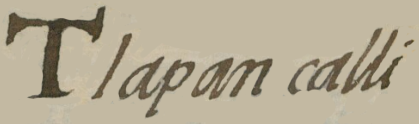
Tlapan calli
tlapancalli
Stephanie Wood
1577
Jeff Haskett-Wood
arquitectura, casas, edificios, terrazas
tlapancal(li), flat-roofed house, upper room, or a house with terrace on the roof, https://nahuatl.wired-humanities.org/content/tlapancalli
la casa de dos pisos, la casa con terraza, o un cuarto en el techo
Stephanie Wood
Available at Digital Florentine Codex/Códice Florentino Digital, edited by Kim N. Richter and Alicia Maria Houtrouw, "Book 11: Earthly Things", fol. 242r, Getty Research Institute, 2023. https://florentinecodex.getty.edu/en/book/11/folio/242r/images/0. Accessed 16 November 2025.
Images of the digitized Florentine Codex are made available under the following Creative Commons license: CC BY-NC-ND (Attribution-NonCommercial-NoDerivs 4.0 International). For print-publication quality photos, please contact the Biblioteca Medicea Laurenziana ([email protected]). The Library of Congress has also published this manuscript, using the images of the World Digital Library copy. “The Library of Congress is unaware of any copyright or other restrictions in the World Digital Library Collection. Absent any such restrictions, these materials are free to use and reuse.”