yacacolli (FCbk11f252v)
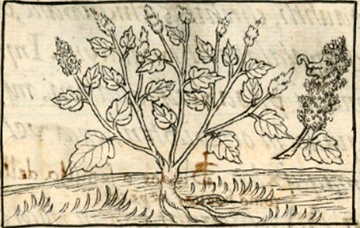
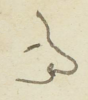
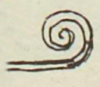
This is a black and white sketch of a compound hieroglyph. The term selected for this example comes from the text on the page prior to the image in the Digital Florentine Codex. There is no gloss, per se. This example shows a sprig of an amaranth plant with one leaf. The sprig includes the seed cluster (huauhtli) with a profile of a face protruding off to the left near the top of the seed cluster. This face has a pronounced nose (yacatl) with a curl (colli) coming out of it. The curl is something like a speech scroll, but speech is not indicated in this case. These elements apparently have semantic values relating to their shapes.
Stephanie Wood
The two latter elements suggest that this type of amaranth seed cluster might have a curling tip. Instead of drawing the seed cluster with such a shape, however, the tlacuilo has added two hieroglyphic elements that were still recognizable as such at this late date. In the Florentine Codex, huauhtli plant variations are numerous, but the drawings often look remarkably alike. The use of compound hieroglyphs next to the plants helps to clarify which plant is which, although some have no hieroglyphs.
Stephanie Wood

Iaca colli
yacacolli
Stephanie Wood
1577
Jeff Haskett-Wood
plantas, planta, comida, semilla, semillas, un punto curvo
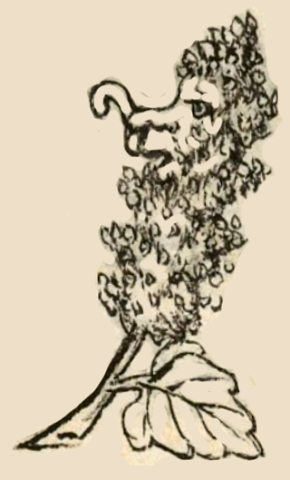
yacacolli, “point-twisted,” a type of amaranth, https://nahuatl.wired-humanities.org/content/yacacolli
yaca(tl), nose, point, https://nahuatl.wired-humanities.org/content/yacatl
col(li), bent, twisted, curling, https://nahuatl.wired-humanities.org/content/colli
un tipo de amaranto (posiblemente con una punta torcida)
Stephanie Wood
Available at Digital Florentine Codex/Códice Florentino Digital, edited by Kim N. Richter and Alicia Maria Houtrouw, "Book 11: Earthly Things", fol. 252v, Getty Research Institute, 2023. https://florentinecodex.getty.edu/en/book/11/folio/252v/images/0 Accessed 16 November 2025.
Images of the digitized Florentine Codex are made available under the following Creative Commons license: CC BY-NC-ND (Attribution-NonCommercial-NoDerivs 4.0 International). For print-publication quality photos, please contact the Biblioteca Medicea Laurenziana ([email protected]). The Library of Congress has also published this manuscript, using the images of the World Digital Library copy. “The Library of Congress is unaware of any copyright or other restrictions in the World Digital Library Collection. Absent any such restrictions, these materials are free to use and reuse.”