acalli (FCbk12f55r)
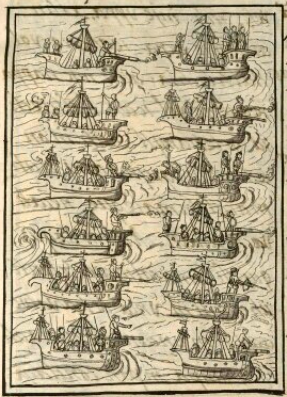
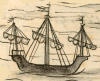
This iconographic example features a black and white sketch of two Spanish brigantines (involving the noun, acalli), with which the invaders attacked Tenochtitlan from the water. It is included in this digital collection for the purpose of making comparisons with related hieroglyphs. The term selected for this example comes from the text near the image in the Digital Florentine Codex. There is no gloss, per se. This example shows two of the twelve brigantines that appear in the contextualizing image. One of these has a cannon on board, and the other has a harquebus. Both boats have men with shields and lances, prepared for the attack. The Spaniards built these boats in 1521 to be able to maneuver on the sometimes shallow lakes surrounding the city in their final siege.
Stephanie Wood
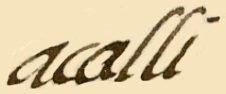
While an acalli was originally a canoe for the Nahuas, the term acalli was also used for the Spanish ship and for the brigantine. While these could look like hieroglyphs, examples so far in this collection are iconographic.
Stephanie Wood
acalli
Stephanie Wood
1577
Jeff Haskett-Wood
barco, barcos, lancha, lanchas, brigantinas
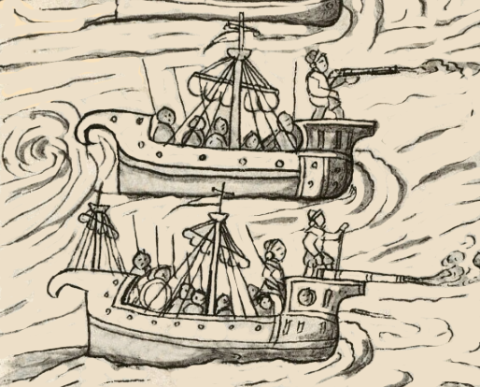
acal(li), a boat, in this case, Spanish brigantines, https://nahuatl.wired-humanities.org/content/acalli
la brigantina
Stephanie Wood
Available at Digital Florentine Codex/Códice Florentino Digital, edited by Kim N. Richter and Alicia Maria Houtrouw, "Book 12: Conquest of Mexico", fol. 55r, Getty Research Institute, 2023. https://florentinecodex.getty.edu/en/book/12/folio/55r/images/0 Accessed 7 February 2026.
Images of the digitized Florentine Codex are made available under the following Creative Commons license: CC BY-NC-ND (Attribution-NonCommercial-NoDerivs 4.0 International). For print-publication quality photos, please contact the Biblioteca Medicea Laurenziana ([email protected]). The Library of Congress has also published this manuscript, using the images of the World Digital Library copy. “The Library of Congress is unaware of any copyright or other restrictions in the World Digital Library Collection. Absent any such restrictions, these materials are free to use and reuse.”