iquiti (Osu38v)
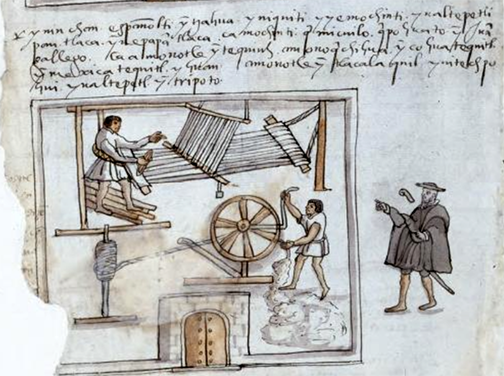
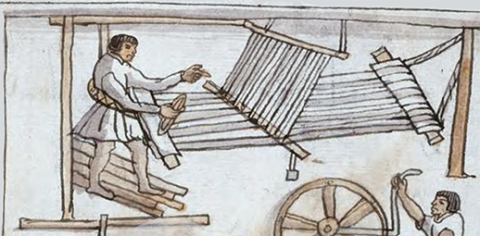
This painted example of Nahua iconography shows a man working an imported European loom. We have chosen the verb iquiti (to weave cloth) from the nearby text to represent this scene. The Nahua man doing the weaving is wearing a belted tunic, another European import. Below him, we can just see another man working with a large spinning wheel, which took the place of drop spindles.
Stephanie Wood
While women were the traditional Mesoamerican weavers, the Europeans encouraged men to get involved using the new technology of the floor looms that the colonizers introduced. See some examples of cloth below, but note that these cloths (ayatl) may well have been made by women on backstrap looms. The cloth made on large floor looms was probably destined for Spanish (colonial or imperial) consumption.
Stephanie Wood

iquiti.
iquiti
Stephanie Wood
1551–1565
Jeff Haskett-Wood
tejer, hilar, algodón, hombre, hombres, tecnología, textiles, trabajo
iquiti, to weave cloth, https://nahuatl.wired-humanities.org/content/iquiti
tejer tela
Stephanie Wood
Library of Congress Online Catalog and the World Digital Library, Osuna Codex, or Painting of the Governor, Mayors, and Rulers of Mexico, https://www.loc.gov/resource/gdcwdl.wdl_07324/. The original is located in the Biblioteca Nacional de España.
"The Library of Congress is unaware of any copyright or other restrictions in the World Digital Library Collection. Absent any such restrictions, these materials are free to use and reuse." But please cite the Biblioteca Nacional de España and this Visual Lexicon of Aztec Hieroglyphs if you use any of these images here or refer to the content on this page, providing the URL