teilpiloyan (Osu37v)
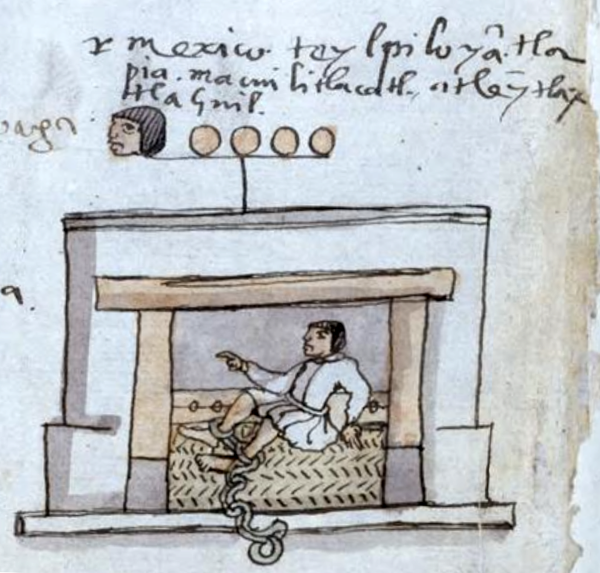
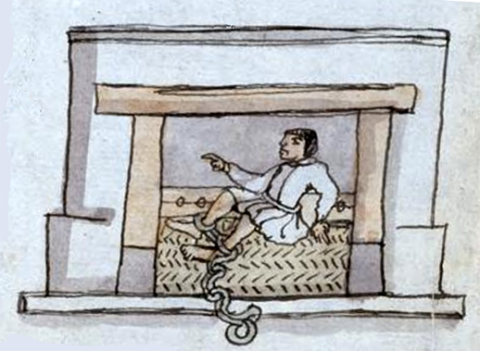
This painted example of Nahua iconography represents the noun teilpiloyan, a jail or prison. Another name for this is teilpilcalli, and this depiction of a jail shows a frontal view of what might be called a calli (house, building). It is white stucco with some shading for three-dimensionality, especially on the left side. It has a beam-lined entrance; this wood is a tan color. Inside one can see a woven mat (what should be called a petlatl) with a Nahua man sitting on it. He wears a belted white cotton tunic. His skin is a generic flesh-tone. A chain (cadena, the Spanish equivalent, entered Nahuatl as a loanword, although it is not used in the text here, nor is the Nahuatl term for an iron chain, tepozmecatl) detains the man by his ankles, and the extra length of the chain (colored gray) comes out the front door. Behind the man are some wooden stocks (possibly called cuauhcoyoctli, cuauhcocoyoctli or cuauhicxitl), apparently not in use at that moment.
Stephanie Wood
In some other examples below, compare the way this man is restrained.
Stephanie Wood
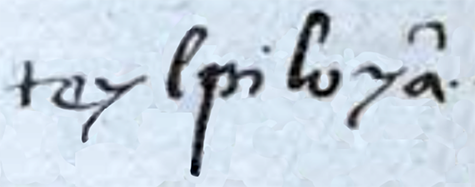
teylpiloyā.
teilpiloyan
Stephanie Wood
1551–1565
Jeff Haskett-Wood
cepo, cepos, cadenas, contener a alguien, custodia, cárceles, prisión
teilpiloyan, jail, https://nahuatl.wired-humanities.org/content/teilpiloyan
te- (non-specific human object prefix), https://nahuatl.wired-humanities.org/content/te
ilpia, to tie someone up or take someone into custody, https://nahuatl.wired-humanities.org/content/ilpia
-yan (locative suffix), place where action is taken habitually, https://nahuatl.wired-humanities.org/content/yan
la cárcel
Stephanie Wood
Library of Congress Online Catalog and the World Digital Library, Osuna Codex, or Painting of the Governor, Mayors, and Rulers of Mexico, https://www.loc.gov/resource/gdcwdl.wdl_07324/. The original is located in the Biblioteca Nacional de España.
"The Library of Congress is unaware of any copyright or other restrictions in the World Digital Library Collection. Absent any such restrictions, these materials are free to use and reuse." But please cite the Biblioteca Nacional de España and this Visual Lexicon of Aztec Hieroglyphs if you use any of these images here or refer to the content on this page, providing the URL