
Ahuacatlan (Mdz39r)
This compound Nahuatl hieroglyph for the place name Ahuacatlan consists of an avocado (ahuacatl) tree with embedded teeth (tlantli), the latter providing the phonetic value for the locative suffix, -tlan (near). The tree has a leader and two additional branches, plus some extra leaves, and red curly roots. The tree appears to provide a frontal view. The teeth are white, and the mouth--which is in profile facing to the viewer's right--is slightly open.
Stephanie Wood
Este jeroglífico nahua compuesto que representa el topónimo «Ahuacatlan» muestra un árbol de aguacate (ahuacatl) en el que figuran unos dientes (tlantli) que aportan el valor fonético del sufijo locativo -tlan (cerca). El árbol presenta un tronco con dos ramas, algunas hojas y raíces rojas onduladas. El árbol parece estar representado desde un ángulo frontal. Los dientes son blancos y la boca, que se encuentra de perfil mirando hacia la derecha del espectador, se muestra ligeramente abierta.
The locative suffix, as given in the gloss for the place name, is -tla (or -tlah, if we show the glottal stop), which suggests a place where avocados are abundant. But, given the teeth, the final (-n) was probably inadvertently omitted, and the locative suffix is -tlan. As Gordon Whittaker has discovered, the full mouth of teeth can often imply the locative suffix -tlan with a ligature -ti-, resulting in the post-position -titlan. But this is an exception and the ligature does not appear in this place name.
Stephanie Wood
El sufijo locativo, indicado en la glosa del topónimo, es -tla (o -tlah, si se escribe como oclusiva glotal), que significa «lugar donde abundan los aguacates». Sin embargo, la presencia de los dientes sugiere que el sufijo final (-n) probablemente se omitió en la glosa, por lo que el sufijo locativo completo sería -tlan. Como apunta Gordon Whittaker, la boca con dientes suele indicar que el sufijo locativo -tlan está unido a -ti, lo que resulta en la posposición -titlan. No obstante, este caso es una excepción, ya que la unión no se manifiesta en este topónimo.
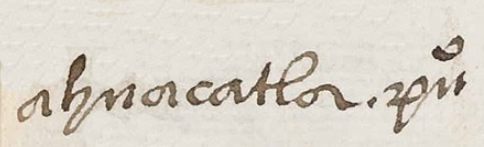
ahuacatla. puo
Ahuacatlan, pueblo
Stephanie Wood
c. 1541, but by 1553 at the latest
Stephanie Wood
avocados, trees, roots, teeth, dientes, aguacates, árboles, raíces, nombres de lugares, fonetismo, place names, topónimos
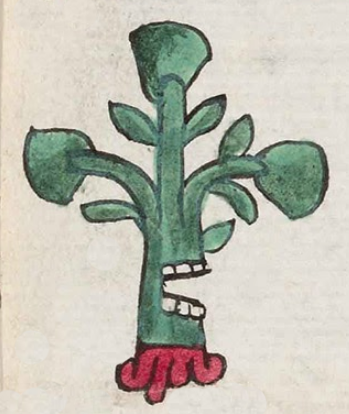
ahuaca(tl), avocado, avocado tree, https://nahuatl.wired-humanities.org/content/ahuacatl
tlan(tli), tooth/teeth, https://nahuatl.wired-humanities.org/content/tlantli
-tlan (locative suffix), by, near, among, https://nahuatl.wired-humanities.org/content/
"Avocado Place" [Frances Karttunen, unpublished manuscript, used here with her permission.]
"By the Avocados" (Whittaker, 2021, 101); "Where There are Many Avocados" (Berdan and Anawalt, 1992, vol. 1, p. 169).
AHUACA-tlan2
"Lugar de Aguacates"
Stephanie Wood
Codex Mendoza, folio 39 recto, https://codicemendoza.inah.gob.mx/inicio.php?lang=english
Original manuscript is held by the Bodleian Libraries, University of Oxford, MS. Arch. Selden. A. 1; used here with the UK Creative Commons, “Attribution-NonCommercial-ShareAlike 3.0 License” (CC-BY-NC-SA 3.0)