ahuitzotl (FCbk11f71r)
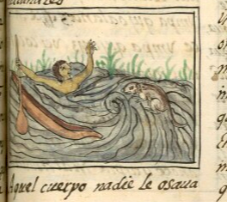
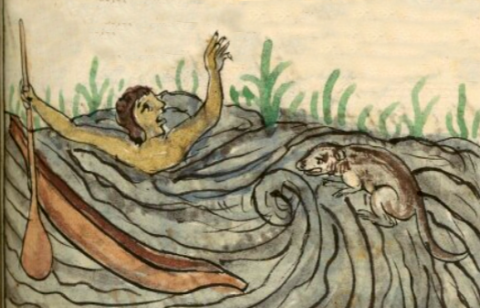
This iconographic example features a legendary water animal (ahuitzotl) who was believed to hunt people, a reversal of the usual human who hunts animals. It is included in this digital collection for the purpose of making comparisons with related hieroglyphs. The term selected for this example comes from the text near the image in the Digital Florentine Codex. There is no gloss, per se. This example shows a man in profile, facing right, in deep water, and holding onto a paddle. He has fallen out of his canoe. His mouth is open, and his left arm is raised as though he is crying for help. On the right side of the scene is the ahuitzotl, a brown, four-legged animal with a long tail. It may be an otter, nutria, or perhaps an amphibious marsupial. This animal, which looks relatively benign and calm here, was believed to be able to reach up from under the water and pull humans down, drowning them, by using a hand attached to a long tail. The text on 71r describes the terrible fate of the body of someone killed by the ahuitzotl. The text, in fact, expands over several pages, providing more information about the corpse, and another scene of the ahuitzotl hunting humans appears on folio 72v. On 73r, yet an additional story tells of a woman who captured an ahuitzotl, put it in a water jug (comitl), and went to show it to the lords, who perceived it to be a divine force (teotl). The water here looks stirred up and treacherous, which is also described in the text. The swirling whirlpool here is a regular feature of bodies of water painted in a Nahua style. The grass growing along the top of the water (presumably a shore), however, suggests European artistic influence that pushed for a landscape setting.
Stephanie Wood
Este ejemplo iconográfico nos muestra un animal acuático legendario (ahuitzotl), del cual se creía que cazaba humanos, en vez de la situación más usual de un humano que caza animales; y lo incluimos en esta colección digital para poder compararlo con otros jeroglíficos relacionados. El término seleccionado para este ejemplo proviene del texto cerca de la imagen en el Códice Florentino Digital, aunque no cuenta con una glosa en sí. Se nos presenta a un hombre de perfil que mira hacia la derecha, caído de su canoa en medio de aguas profundas, con un remo en la mano derecha, la boca abierta y el brazo izquierdo levantado como si pidiese ayuda. En la mitad derecha de la imagen se observa al ahuitzotl, un cuadrúpedo rabilargo de color marrón: podría tratarse de una nutria, un roedor acuático o algún marsupial anfibio. Se creía que este animal atacaba a los nadadores con su cola terminada en una mano para arrastrarlos al fondo de las aguas y ahogarlos, aunque en este ejemplo tiene un aspecto relativamente benigno y tranquilo. El texto en 71r describe el espantoso destino de los cuerpos de las víctimas del ahuitzotl; de hecho, la descripción se extiende a lo largo de varias páginas y nos proporciona información adicional sobre los cadáveres, con una escena más del ahuitzotl a la caza de humanos en el folio 72v. En 73r, otro relato nos cuenta sobre una mujer que capturó un ahuitzotl, lo puso en una jarra de agua (comitl) y fue a mostrárselo a los señores de la comarca, quienes se dieron cuenta de que se trataba de una entidad divina (teotl). El agua aparece agitada y traicionera y así se describe en el texto, mientras que el remolino aquí presente es una característica común de los cuerpos de agua pintados al estilo nahua; aunque el pasto que crece en el borde superior del agua (que suponemos es una costa) nos indica una influencia artística europea que exigía mostrar la acción como parte de un paisaje.
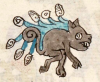
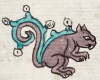
Ahuitzotl was the name of the eighth ruler of Tenochtitlan, and so there are some glyphs associated with his name in this collection. They are all compound hieroglyphs that include a long-tailed animal and, often, some swirling water. See some examples below. The example from folio 13r of the Codex Mendoza includes a photo of a pre-contact stone carving of an ahuitzotl. It reveals a hand attached to the end of the animal’s tail, capable of grabbing someone on the water and pulling that person under.
Stephanie Wood
Ahuitzotl fue el nombre del octavo gobernante de Tenochtitlan, por lo cual contamos con varios glifos asociados a su nombre en nuestra colección, todos los cuales son jeroglíficos compuestos que comprenden un animal rabilargo, frecuentemente acompañado de agua arremolinada: véanse los ejemplos más abajo. El ejemplar del folio 13r del Códice Mendoza incluye una fotografía del tallado prehispánico en piedra de un ahuitzotl, el cual cuenta con una mano al extremo de su cola que le permitía apoderarse de un nadador y arrastrarlo bajo el agua.
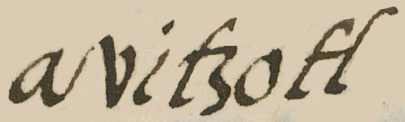
avitzotl
ahuitzotl
Stephanie Wood
1577
Jeff Haskett-Wood
Ahuitzotzin
ahuitzo(tl), a legendary animal, https://nahuatl.wired-humanities.org/content/ahuitzotl
un animal mítico, parecido a una nutria
Stephanie Wood
Available at Digital Florentine Codex/Códice Florentino Digital, edited by Kim N. Richter and Alicia Maria Houtrouw, "Book 11: Earthly Things", fol.71r, Getty Research Institute, 2023. https://florentinecodex.getty.edu/en/book/11/folio/71r/images/0 Accessed 16 October 2025.
Images of the digitized Florentine Codex are made available under the following Creative Commons license: CC BY-NC-ND (Attribution-NonCommercial-NoDerivs 4.0 International). For print-publication quality photos, please contact the Biblioteca Medicea Laurenziana ([email protected]). The Library of Congress has also published this manuscript, using the images of the World Digital Library copy. “The Library of Congress is unaware of any copyright or other restrictions in the World Digital Library Collection. Absent any such restrictions, these materials are free to use and reuse.”