amochitl (FCbk11f215r)
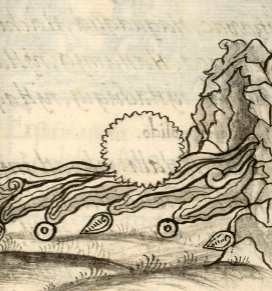
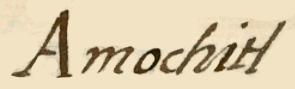
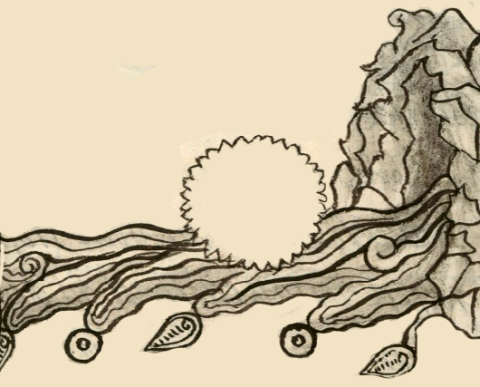
This compound Nahuatl hieroglyph shows a cave with water (atl, the phonetic clue that this term starts with a-) gushing forth. Sitting atop the water appears to be a saw blade, but it must be made from of tin (amochitl), given that the nearby text discusses tin, mentioning the name and noting a visual relationship to foam and vapor (mochitl), which have a white-like appearance similar to the metal and are said to be “somewhat beautiful.” Thus, these elements are potentially both phonetic and/or logographic. Incidentally, the text also references the existence of a “mother-tin.”
Stephanie Wood
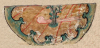
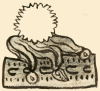
This digital collection has neither a glyph for mochitl or amochitl so far (December 2025), but this example of a late-evolution compound glyph is a valuable contribution. The water is more of a river than the old hieroglyphs or elements for atl, but it does have the usual lines of current, the droplets or chalchihuitl beads, and the cilin shells splashing off. More of a late evolution is the element that is “tin,” especially if it is a saw blade. It is reminiscent of the tepozahuatl metal spur identified by Juan José Batalla in the glyph for Mazahuatl (MH517v, see below). If so, this suggests European technological influence. But it may simply be a reference to the shine on the metal. The cave in this scene is a landscape feature that suggests European artistic influence. Other, earlier ways of drawing caves appear below.
Stephanie Wood
Amochitl
amochitl
Stephanie Wood
1577
Jeff Haskett-Wood
hoja de sierra, tecnología, agua, cueva, cuevas
amoch(itl), tin, https://nahuatl.wired-humanities.org/content/amochitl
moch(itl), foam, vapor, smoke, scum, https://nahuatl.wired-humanities.org/content/mochitl
el plomo
Stephanie Wood
Available at Digital Florentine Codex/Códice Florentino Digital, edited by Kim N. Richter and Alicia Maria Houtrouw, "Book 11: Earthly Things", fol. 215r, Getty Research Institute, 2023. https://florentinecodex.getty.edu/en/book/11/folio/215r/images/0 Accessed 16 November 2025.
Images of the digitized Florentine Codex are made available under the following Creative Commons license: CC BY-NC-ND (Attribution-NonCommercial-NoDerivs 4.0 International). For print-publication quality photos, please contact the Biblioteca Medicea Laurenziana ([email protected]). The Library of Congress has also published this manuscript, using the images of the World Digital Library copy. “The Library of Congress is unaware of any copyright or other restrictions in the World Digital Library Collection. Absent any such restrictions, these materials are free to use and reuse.”