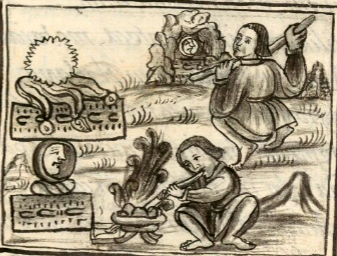
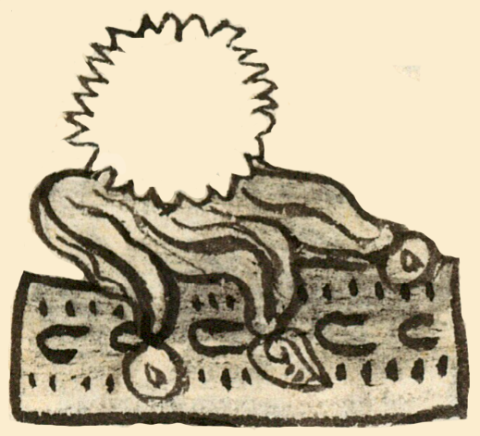
amochitl tlalli (FCbk11f215v)
This compound hieroglyph with three elements refers to the land (tlalli) where tin (amochitl) is found. It shows what may be a saw blade made of tin, or perhaps a reference to the shine on the metal. Below that element is a horizontally flowing water (atl, which provides the phonetic syllable a- to the start of the term), with the classic lines of current and droplets or beads and a shell splashing off the little streams. Under the water is a rectangle drawn in a classic way to represent a parcel of land (tlalli) but referring to the landscape where tin would likely be found.
Stephanie Wood
A three-element compound hieroglyph is fairly rare in the Florentine Codex. Furthermore, the elements of water and land, especially, preserve pre-contact design elements. However, the element for “tin,” especially if it is a saw blade (a colonial technological development), is reminiscent of the tepozahuatl (metal spur for horseback riding) identified by Juan José Batalla in the glyph for Mazahuatl (MH517v, see below). If so, this suggests some European influence. Otherwise, perhaps it represents the light that shimmers on foam and vapor, possible characteristics of tin according to the text. If this is the case, then what appears to be a saw blade may really be a sun that shines, somewhat in the manner of Tonal (MH779r).
Stephanie Wood
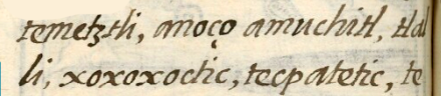
…amuchitl, tlalli…
…amochitl tlalli.
Stephanie Wood
1577
Jeff Haskett-Wood
hoja de sierra, metal, metales, tierras, piedras, mineral, minerales, agua, caracol, caracoles, jades, gota, gotas, lijar, pulir
amochi(tl), tin, https://nahuatl.wired-humanities.org/content/amochitl
tlal(li), land, https://nahuatl.wired-humanities.org/content/tlalli
a(tl), water, https://nahuatl.wired-humanities.org/content/atl
la tierra del plomo
Stephanie Wood
Available at Digital Florentine Codex/Códice Florentino Digital, edited by Kim N. Richter and Alicia Maria Houtrouw, "Book 11: Earthly Things", fol. 215v, Getty Research Institute, 2023. https://florentinecodex.getty.edu/en/book/11/folio/215v/images/0 Accessed 16 November 2025.
Images of the digitized Florentine Codex are made available under the following Creative Commons license: CC BY-NC-ND (Attribution-NonCommercial-NoDerivs 4.0 International). For print-publication quality photos, please contact the Biblioteca Medicea Laurenziana ([email protected]). The Library of Congress has also published this manuscript, using the images of the World Digital Library copy. “The Library of Congress is unaware of any copyright or other restrictions in the World Digital Library Collection. Absent any such restrictions, these materials are free to use and reuse.”