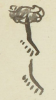
Atemoc (Verg41r)
This compound Nahuatl hieroglyph is a black-line drawing of the personal name Atemoc (“Water Descended”), which is attested here as a man’s name. The compound includes three elements. Beginning at the top is a stream of water (atl) with lines of current (visual movement) and five little splashes with alternating turbinate shells and droplets or beads. This water provides the phonetic syllable -a- which is the start to the name. It is also semantic, as it is the subject of the name. Next is the phonetic syllable -te- displayed in the form of a stone (tetl). Finally, below the stone are two alternating footprints (which also show motion) pointing downward. These are a logogram indicating the semantic verb temo (to descend).
Stephanie Wood
A person named Atemoc was one of “four men who created the gods” in a pre-contact creation story published in “Molina Redivivo,” in Investigaciones Lingüisticas, v. 3 (1935), 391. This act was also associated with a deluge, which seems fitting for the name, but other men in his company included Itzcoatl and Tenoch. This is the first example of a glyph for Atemoc entering the Visual Lexicon (as of March 2026), but there is another one that is very similar on folio 46 verso. There are other hieroglyphs in this collection for people named Temoc who appear in other manuscripts. All of these include descending footprints, and two include a stone (tetl) for the phonetic syllable Te-.
Stephanie Wood

aol. atemoc.
Alonso Atemoc
Stephanie Wood
1539
Jeff Haskett-Wood
verbo, verbos, pretérito, agua, huellas, piedras, caracoles, movimiento, nombres de hombres, men’s names, fonetismo

atl, water, https://nahuatl.wired-humanities.org/content/atl
temo, to descend, https://nahuatl.wired-humanities.org/content/temo
-c, preterit marker, https://nahuatl.wired-humanities.org/content/c-3
El Agua Cayó
Stephanie Wood
Available at Codex Vergara, folio 41r, https://gallica.bnf.fr/ark:/12148/btv1b84528032/f89.item.zoom, accessed 14 March 2026. The Vergara is associated with Tepetlaoztoc, in the larger region of Tetzcoco, c. 1539–1543. “Source gallica.bnf.fr / BnF.” We would also appreciate a citation to the Visual Lexicon of Aztec Hieroglyphs, https://aztecglyphs.wired-humanities.org/.
Image Rights: The non-commercial reuse of images from the Bibliothèque nationale de France is free as long as the user is in compliance with the legislation in force and provides the citation: “Source gallica.bnf.fr / Bibliothèque nationale de France” or “Source gallica.bnf.fr / BnF.” We would also appreciate a citation to the Visual Lexicon of Aztec Hieroglyphs, https://aztecglyphs.wired-humanities.org/