Atzoyatla (TK206r)
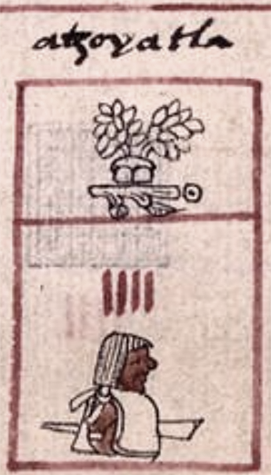
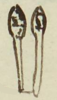
This black-line drawing of the compound Nahuatl hieroglyph that represents the place name Atzoyatla (perhaps, “The Water at the Abundant Palm Grove”) contains three elements. It reads up and down, starting with a little stream of water (atl), providing the At- start to the name. Moving up to the top element, the next reading consists of what may be two palm trees that refer to a palm grove (zoyatla). Finally, the element in the middle is a pair of front teeth (tlantli) with gums above, which provide the phonetic syllable -tla- for the locative suffix that comes at the end of the place name.
Stephanie Wood
The -tla suffix refers to abundance, but there is always the possibility with -tla that -tlan is meant and the final “n” has inadvertently dropped away. In that case it would be positional and not about abundance. See below for another way of drawing a zoyatl.
Side Note: The folio numbers are not always clear in the copy published online by the British Museum. Marc Thouvenot gives this page the number K04_A in his TLACHIA digital collection, https://tlachia.iib.unam.mx/tepetlaoztoc/K04_A.
Stephanie Wood
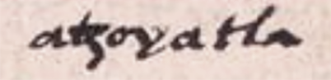
atzoyatla
Atzoyatla or Azoyatla
Stephanie Wood
c. 1556
Jeff Haskett-Wood
palma, palmas, árbol, árboles, arboleda, agua, nombres de lugares, topónimo, topónimos, fonetismo
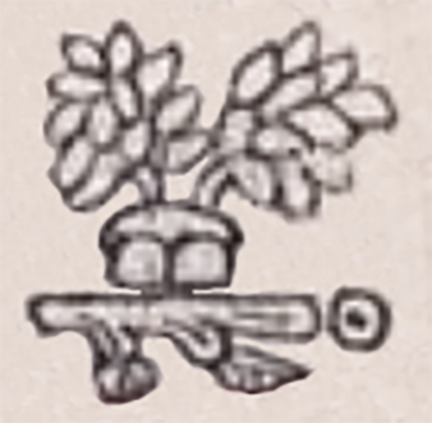
zoyatla, palm grove, https://nahuatl.wired-humanities.org/content/zoyatla
a(tl), water, https://nahuatl.wired-humanities.org/content/atl
posiblemente, El Agua Junto al Palmar Abundante
Stephanie Wood
The Codex Kingsborough, also known as the Códice de Tepetlaoztoc, and the Memorial de los indios de Tepetlaoztoc, is not on display. It was transferred from the British Library and is now held by the British Museum. It is shared on line at: https://www.britishmuseum.org/collection/object/E_Am2006-Drg-13964
©The Trustees of the British Museum. Shared under a Creative Commons Attribution-Non-Commercial-ShareAlike 4.0 International (CC BY-NC-SA 4.0) license. Please also cite the <em>Visual Lexicon of Aztec Hieroglyphsem>, ed. Stephanie Wood (Eugene, Ore.: Wired Humanities Projects, 2020-present) and this URL.