centzontlatole (FCbk11f55v)
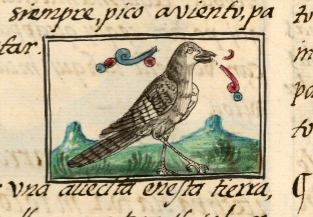
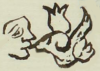
This iconographic example, featuring a mockingbird (centzontlatole, or centzontlahtoleh, literally, “possessor of 400 words”), is included in this digital collection for the purpose of making comparisons with related hieroglyphs. The term selected for this example comes from the Nahuatl text near the image in the Digital Florentine Codex. There is no gloss, per se. This example shows a painting of a gray and white bird, in profile, facing right. Its legs are crossed, seemingly suggesting movement along the landscape. The landscape is green and blue. Placing an animal in a landscape setting is done in such a way as to suggest European artistic influences, but the placement of two peaks may authentically reveal the Mesoamericans’ considerable interest in nearby peaks or mountains in their surroundings. Coming out of the mockingbird’s mouth is a dotted line leading to two speech scrolls. One is red, and it has a blue bead (of water or turquoise, both being precious) on the outside of the volute’s curl. Above this elaborated speech scroll is a smaller, simpler scroll that curls upward. It is also painted red, one of the colors associated with writing and painting. Seemingly underlining visually the large number of sounds a mockingbird can make, behind the bird’s head is another speech scroll, this one turquoise blue with one red bead near the start of the volute and another red and blue bead in a line that comes outward from the outside of the scrolling part of the volute. We should probably discount the literal translation of centzontlatole, and think of something along the lines of a bird with “many songs.” On another page in this section of the manuscript that treats birds, the word tlatolli refers to birdsong and 400 can just imply a large number.
Stephanie Wood
The elaboration of speech scrolls is worth tracking for the various kinds of differentiation on standard speech that can appear in Nahuatl hieroglyphic writing, sometimes indicating song, or elite status, or a religious significance. Some scrolls also point to air movement, smoke curls, the passing of gas, and more. The varying coloration of volutes also deserves further attention in order to reveal embedded meaning. See our short article on “Scrolls: Air and Sound,” on the left-hand navigation bar.
Stephanie Wood
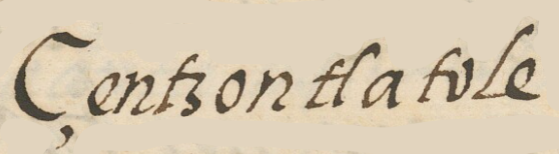
Çentzontlatole
centzontlatole
Stephanie Wood
1577
Jeff Haskett-Wood
pirar, gorjear, chirriar, trinar, cantar trinando, songbird, pájaro cantor, pájaros, ave, aves, volutas, cuentas, cuatrocientos, pluma, plumas, animals, animales
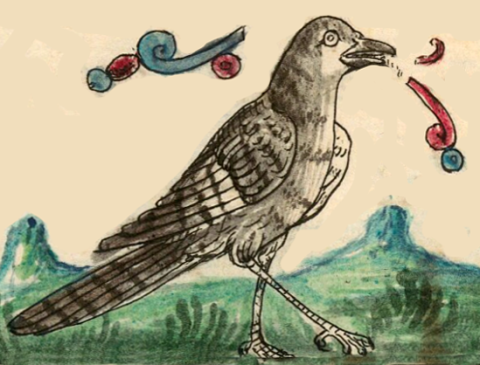
centzontlatole, a mocking bird, https://nahuatl.wired-humanities.org/content/centzontlatole
centzton(tli), 400, https://nahuatl.wired-humanities.org/content/centzontli
tlatol(li), word(s), https://nahuatl.wired-humanities.org/content/tlatolli
el pájaro que canta mucho, el sinsonte (una hispanización de centzontli, 400), o zenzontle, o centzontle
Stephanie Wood
Available at Digital Florentine Codex/Códice Florentino Digital, edited by Kim N. Richter and Alicia Maria Houtrouw, "Book 11: Earthly Things", fol. 55v, Getty Research Institute, 2023. https://florentinecodex.getty.edu/en/book/11/folio55v/images/0 Accessed 16 October 2025.
Images of the digitized Florentine Codex are made available under the following Creative Commons license: CC BY-NC-ND (Attribution-NonCommercial-NoDerivs 4.0 International). For print-publication quality photos, please contact the Biblioteca Medicea Laurenziana ([email protected]). The Library of Congress has also published this manuscript, using the images of the World Digital Library copy. “The Library of Congress is unaware of any copyright or other restrictions in the World Digital Library Collection. Absent any such restrictions, these materials are free to use and reuse.”