Chahuazquimetl (TK207v)
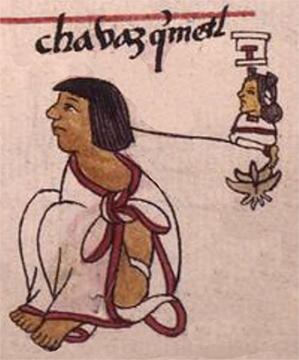
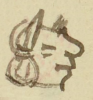
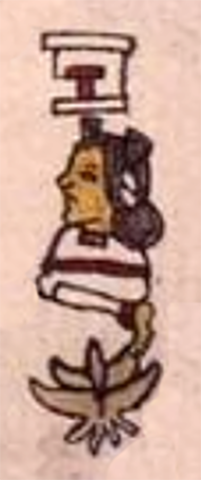
This painted compound Nahuatl hieroglyph represents the personal name Chahuazquimetl (perhaps “The Subject of Women’s Jealousy” or perhaps their cruelty), attested here as a man’s name. The compound has three elements, and the reading order is downward. The first element is what appears to be a house, which is usually a calli, but here it is a chantli, a home. Chantli supplies the phonetic syllable -cha- for the start of the name. The next element is a semantic contributor. It shows a woman seated in the classic posture with her legs underneath her. Her hairstyle and clothing are also classic for an adult woman. She apparently serves here as a commentary on women, in general, because she has been chosen to represent “jealous women” (chahuazquime). Finally, the third element at the bottom is an agave plant (metl), which provides the phonetic syllable that appears at the end of the name (as glossed). It may be unusual to turn the plural suffix -me (or -meh with the glottal stop) into a substantive suffix, -metl, but sometimes personal names do not follow the same rules as nouns that are not proper.
Stephanie Wood
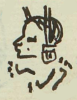
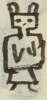
We are tracking men’s names that in some way refer to women. See the Advanced Search, open the Cultural Content drop-down menu, and choose: “names (men’s but w/ female dimension).” A few examples appear below. Many start with Cihua-, and many contain some form of nenetl, which can refer to a doll, a figurine, a lazy woman, or a woman’s genitals.
Side Note: The folio numbers are not always clear in the copy published online by the British Museum. Marc Thouvenot gives this page the number K05_B in his TLACHIA digital collection, https://tlachia.iib.unam.mx/tepetlaoztoc/K05_B.
Stephanie Wood
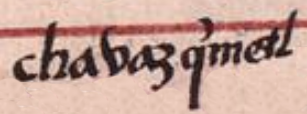
chavazq~metl
Chahuazquime
Stephanie Wood
c. 1556
Jeff Haskett-Wood
maguey, mujeres celosas, chismosas, cruel, crueldad, arrogancia, renzillo, nombres de hombres, men’s names, fonetismo, favorite
chan(tli), home, https://nahuatl.wired-humanities.org/content/chantli
chahuazquime, jealous, quarrelsome, cruel, or arrogant women, https://nahuatl.wired-humanities.org/content/chahuazquime
me(tl), agave, https://nahuatl.wired-humanities.org/content/metl
cihua(tl), woman, https://nahuatl.wired-humanities.org/content/cihuatl
posiblemente, El Objeto de los Celos de las Mujeres
Stephanie Wood
The Codex Kingsborough, also known as the Códice de Tepetlaoztoc, and the Memorial de los indios de Tepetlaoztoc, is not on display. It was transferred from the British Library and is now held by the British Museum. It is shared on line at: https://www.britishmuseum.org/collection/object/E_Am2006-Drg-13964
©The Trustees of the British Museum. Shared under a Creative Commons Attribution-Non-Commercial-ShareAlike 4.0 International (CC BY-NC-SA 4.0) license. Please also cite the <em>Visual Lexicon of Aztec Hieroglyphsem>, ed. Stephanie Wood (Eugene, Ore.: Wired Humanities Projects, 2020-present) and this URL.