Chichiccuauhtla (Mdz32r)
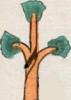
This compound Nahuatl hieroglyph stands for the place name, Chichiccuauhtla ("Where Chichiccuahuitl Trees Abound"). Bitter trees or quinine trees are additional translations. The hieroglyph features a representation of a dog (chichi), in profile, facing to the right, crouching or lying on the ground, and with a red tongue protruding. The dog is white with large black spots and a long tail. Its ears are erect and pointing forward, and some of its teeth are visible. The dog serves as a phonetic indicator for the start of the place name Chichic-. Emerging from the back of the dog is a standard tree (cuahuitl), with a leader and two branches, two-tone green foliage at the end of each branch, terracotta-colored bark, a thick and a thin diagonal stripe across the trunk. The stripes (tlilcuahuitl) are a phonetic indicator that ensures the reading of cuahuitl. The locative suffix (-tla, or -tlah, if we show the glottal stop) is not shown visually.
Stephanie Wood
Este jeroglífico compuesto náhuatl representa el topónimo Chichiccuauhtla (“Abundancia de árboles de chichiccuahuitl”) y nos muestra a un perro (chichi) de perfil que mira hacia la derecha, agazapado o yaciente y con la lengua roja de fuera, rabilargo y de pelaje blanco con grandes manchas negras, además de mostrar algunos de sus dientes y tener las orejas paradas que apuntan hacia adelante. El can funge como un indicador fonético de las dos primeras sílabas del topónimo (Chichic-). Un árbol (cuahuitl) surge de su lomo, con una rama principal y dos secundarias con follaje verde bitonal al extremo de cada una, una corteza color ocre y una franja diagonal gruesa y otra delgada que atraviesan el tronco. Dichas franjas (tlilcuahuitl) son un indicador fonético que nos obliga a leer el glifo como cuahuitl. El sufijo locativo (-tla o -tlah con la oclusiva glotal) no aparece de manera visual.
There is a tree called a chichiccuahuitl, that produces quinine, as described in our Online Nahuatl Dictionary. The Gran Diccionario Nahuatl spells it chichicuahuitl). The gloss supports a reading of chichic- (bitter), which Berdan and Anawalt recognize. The dog (chichi) is there to provide the phonetic information for the start of the name, Chichic-, making it a disyllabogram/phonogram. [See Gordon Whittaker, 2021, 222, for a list of similar disyllabograms.] The tree (cuahuitl) is a logogram for the second part of the name. The black stripes (tlilcuahuitl) are another phonogram.
Stephanie Wood
En nuestro Online Nahuatl Dictionary se describe un árbol productor de quinina llamado chichiccuahuitl , el cual aparece como chichicuahuitl en el Gran Diccionario Náhuatl. La glosa nos indica que debe interpretarse como chichic- (amargo), con lo cual están de acuerdo Berdan y Anawalt. El perro (chichi) proporciona la información fonética de las dos primeras sílabas del topónimo (Chichic-), lo cual lo convierte en un disilabograma/fonograma: véase una lista de disilabogramas parecidos en Gordon Whittaker (2021: 222). El árbol (cuahuitl) es un logograma para la segunda parte del topónimo, mientras que las franjas negras (tlilcuahuitl) son otro fonograma.
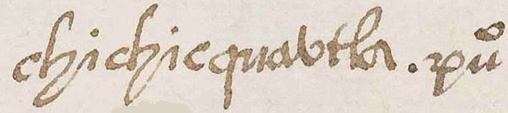
chichicquavtla. puo
Chichicuauhtla, pueblo (or Chichiccuauhtla)
Stephanie Wood
c. 1541, or by 1553 at the latest
Stephanie Wood
dogs, perros, perras, trees, árboles, bitter, amargo, nombres de lugares, fonetismo, a favorite, place names, topónimos

chichi, dog, https://nahuatl.wired-humanities.org/content/chichi
cuahui(tl), tree, https://nahuatl.wired-humanities.org/content/cuahuitl-1
chichiccuahui(tl), a medicinal tree, https://nahuatl.wired-humanities.org/content/chichiccuahuitl
-tlan (locative suffix), https://nahuatl.wired-humanities.org/content/tlan
tlilcuahui(tl), black stripe(s), https://nahuatl.wired-humanities.org/content/tlilcuahuitl
"Where There Are Many Chichiquauhtla Trees" (agreeing with Berdan and Anawalt) [Frances Karttunen, unpublished manuscript, used here with her permission.]
"Where There Are Many Chichiquauhtla Trees" (Berdan and Anawalt, 1992, vol. 1, p. 177)
Codex Mendoza, folio 32 recto, https://digital.bodleian.ox.ac.uk/objects/2fea788e-2aa2-4f08-b6d9-648c00..., image 74 of 188.
The Bodleian Libraries, University of Oxford, hold the original manuscript, the MS. Arch. Selden. A. 1. This image is published here under the UK Creative Commons, “Attribution-NonCommercial-ShareAlike 3.0 License” (CC-BY-NC-SA 3.0).