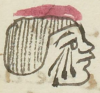
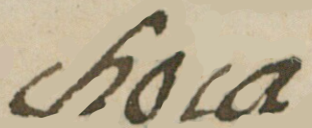
choca (FCbk12f13r)
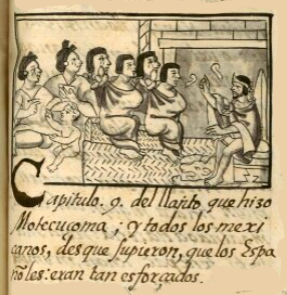
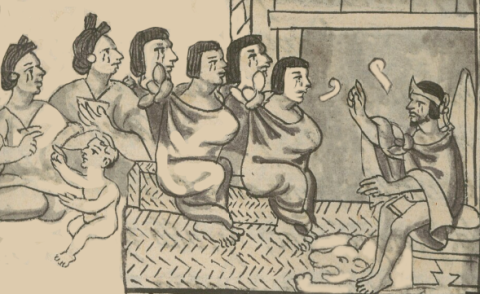
This iconographic example, featuring a black and white sketch of male and female Mexica sitting with Motecuzoma, and all are crying (involving the verb, choca), is included in this digital collection for the purpose of making comparisons with related hieroglyphs. The term selected for this example comes from the text near the image in the Digital Florentine Codex. There is no gloss, per se. This example shows four men and two women in profile, facing right, toward Motecuhzoma. He sits in a palace facing them. He is sitting on what appears to be a wooden drum (huehuetl), with its cut out legs. Under his seat appears to be the skin of a wild cat, with its head and paws still attached. Motecuhzoma gestures and a speech scroll emerges from his mouth. A scroll also emerges from one of the men sitting nearest to him. The men who are meeting with the ruler are all sitting on woven seats (probably icpalli), on top of woven mats (probably petlatl), and the women are seated behind them, on the ground. The men all wear cloaks tied on their shoulders, and the women wear hand-made blouses (huipilli). The textiles are shaded for three dimensionality, an artistic style learned from European art teachers. A child sits on the ground, too, seemingly playing or gesturing to one of the women. That women are included in the meeting with Motecuhzoma seems significant, but the arrangement of the bodies seems gendered in such a way that privileges men. Everyone but the child is crying. Emotions were running strong. The text explains how Motecuhzoma is very concerned about the Spaniards who are marching their way.
Stephanie Wood
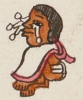
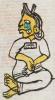
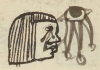
Crying occurs several times in this collection, an emotion expressed by both men and women. In hieroglyphs, the focus is on tears running down the cheek. Early on, the tears were water hieroglyphs, with lines of current and droplets at the tips of the streams.
Stephanie Wood
Stephanie Wood
1577
Jeff Haskett-Wood
mapilhuia, skins, hides, animals, animales, cry, crying, tears, lágrimas, emoción, tambor, drums, Montezuma, volutas, volutes
choca, to cry, https://nahuatl.wired-humanities.org/content/choca
choca
llorar
Stephanie Wood
Available at Digital Florentine Codex/Códice Florentino Digital, edited by Kim N. Richter and Alicia Maria Houtrouw, "Book 12: Conquest of Mexico", fol. 13r, Getty Research Institute, 2023. https://florentinecodex.getty.edu/en/book/12/folio/13r/images/0 Accessed 7 February 2026.
Images of the digitized Florentine Codex are made available under the following Creative Commons license: CC BY-NC-ND (Attribution-NonCommercial-NoDerivs 4.0 International). For print-publication quality photos, please contact the Biblioteca Medicea Laurenziana ([email protected]). The Library of Congress has also published this manuscript, using the images of the World Digital Library copy. “The Library of Congress is unaware of any copyright or other restrictions in the World Digital Library Collection. Absent any such restrictions, these materials are free to use and reuse.”