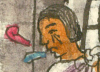
choca (FCbk12f2v)
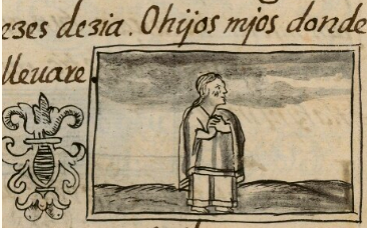
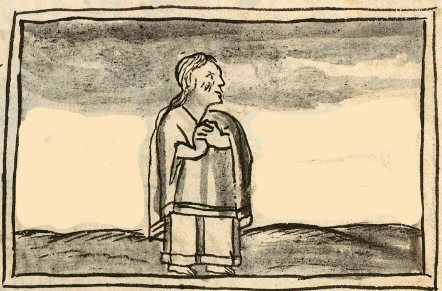
This iconographic example, featuring a black and white sketch of woman who went about crying (involving the verb, choca), is included in this digital collection for the purpose of making comparisons with related hieroglyphs. The term selected for this example comes from the text near the image in the Digital Florentine Codex. There is no gloss, per se. This example shows a woman standing in a ¾ view looking toward the viewer’s right. She has her hands clasped over her chest as though she is moved emotionally. Tears run down her visible right cheek. Her hair seems to be long, probably hanging down her back–not twisted up into the usual adult woman’s hairstyle called the neaxtlahualli or axtlacuilli. The woman wears a huipilli blouse and a long loose skirt or culottes (cueitl in Nahuatl, or naguas, in Spanish). She stands on undulating earth and below a gray sky band. The landscape setting and the shading added to the land and her clothing show European artistic influences. This scene is also boxed in, which is so typical of the Florentine Codex. The text on the same page explains how this woman went about weeping and crying out to “my children,” about how uncertain the future was. This was the sixth omen (tezahuitl) in the period prior to the Spanish invasion.
Stephanie Wood
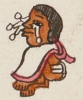
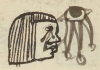
This woman seems to serve as a basis for the figure called La Llorona (the Weeper) of Mexican history and folklore up to the present day. In art, she is often portrayed with her hair down, which is consistent with this image. But for a tezahuitl, she is not as startling or as frightening here as she appears in more contemporary renditions. Crying occurs several times in this collection, an emotion expressed by both men and women. In hieroglyphs, the focus is on tears running down the cheek. Early on, the tears were water hieroglyphs, with lines of current and droplets at the tips of the streams.
Stephanie Wood
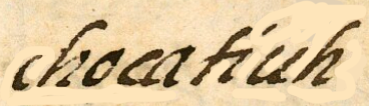
chocatiuh
Stephanie Wood
1577
Jeff Haskett-Wood
mujer, mujeres, llorando, gritando, itinerante, extraviada
choca, to weep, cry, https://nahuatl.wired-humanities.org/content/choca
llorar
Stephanie Wood
Available at Digital Florentine Codex/Códice Florentino Digital, edited by Kim N. Richter and Alicia Maria Houtrouw, "Book 12: Conquest of Mexico", fol. 2v, Getty Research Institute, 2023. https://florentinecodex.getty.edu/en/book/12/folio/2v/images/0 Accessed 7 February 2026.
Images of the digitized Florentine Codex are made available under the following Creative Commons license: CC BY-NC-ND (Attribution-NonCommercial-NoDerivs 4.0 International). For print-publication quality photos, please contact the Biblioteca Medicea Laurenziana ([email protected]). The Library of Congress has also published this manuscript, using the images of the World Digital Library copy. “The Library of Congress is unaware of any copyright or other restrictions in the World Digital Library Collection. Absent any such restrictions, these materials are free to use and reuse.”