cihuapipiltin (TK210v)
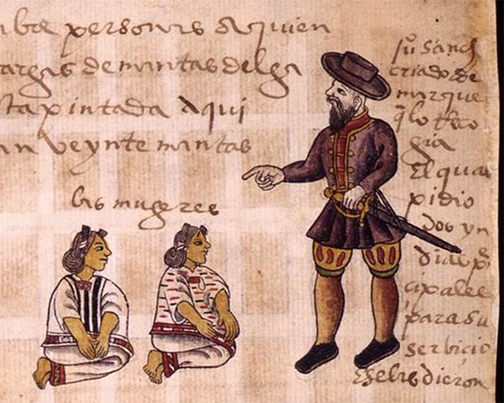
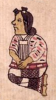
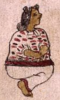
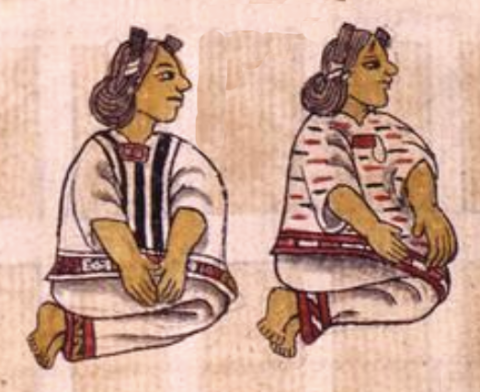
This painted simplex Nahuatl hieroglyph represents two noble Nahua women (cihuapipiltin). There is no Nahuatl language gloss on this image, but there is a Spanish-language explanation of the painting made by a Nahua, and it refers to “indias principalas.” We are presuming the Nahua tlacuilo was therefore painting two that would have been called cihuapipiltin (plural of cihuapilli) in Nahuatl. They are dressed in fine handmade blouses (which they would call a huipilli, although the term is not mentioned here). Their hair is coiffed in the style (neaxtlahualli, but again not mentioned here) of the adult woman, with portions of hair tied and twisted up into points above their forehead. One has a blouse with black vertical stripes and a border along the bottom. Her long skirt is also white with a red border at the bottom. The woman on the right has a huipil with short horizontal markings all over it, plus a red border. Her long skirt also has a border design at the bottom. Both huipiles have the horizontal placard at the bottom of the V-neck, which was common in the sixteenth century. The fabric of their clothing has shaded folds that give it a three-dimensionality, something the tlacuilos learned from colonial instructors. The women are seated in a traditional posture, with their legs bent at the knee and tucked under their bodies. Their hands are down near their laps. In other circumstances, given their status, they might have been gesturing with their hands, such as pointing (what was called mapilhuia).
Stephanie Wood
These two women may have been unmarried, because the Spanish text explains that the assistant to Hernando Cortés, named Juan Sánch[ez?], requested that he be given two women for “servicio.” This was likely domestic service, which often involved more than cooking, cleaning, and nursing, could be permanent, not necessarily consensual, and led to the creation of the first mestizo (mixed heritage) generation. This manuscript was produced as part of the community’s resistance through the court system to the unreasonable taxation being demanded vis-a-vis the size of the community, especially as the population was declining as a result of diseases inadvertently brought over from Europe.
Side Note: The folio numbers are not always clear in the copy published online by the British Museum. Marc Thouvenot gives this page the number K08_B in his TLACHIA digital collection, https://tlachia.iib.unam.mx/tepetlaoztoc/K08_B.
Stephanie Wood
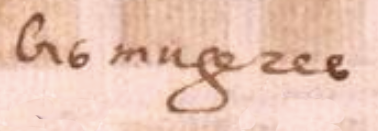
las mugeres
las mujeres
Stephanie Wood
c. 1556
Jeff Haskett-Wood
mujer, tributos, women, jerarquía social indígena, sirvientas, Spaniards, españoles, colonialismo, resistencia
cihuapil(li), noble Nahua woman, https://nahuatl.wired-humanities.org/content/cihuapilli
mujeres nahuas nobles
Stephanie Wood
The Codex Kingsborough, also known as the Códice de Tepetlaoztoc, and the Memorial de los indios de Tepetlaoztoc, is not on display. It was transferred from the British Library and is now held by the British Museum. It is shared on line at: https://www.britishmuseum.org/collection/object/E_Am2006-Drg-13964
©The Trustees of the British Museum. Shared under a Creative Commons Attribution-Non-Commercial-ShareAlike 4.0 International (CC BY-NC-SA 4.0) license. Please also cite the <em>Visual Lexicon of Aztec Hieroglyphsem>, ed. Stephanie Wood (Eugene, Ore.: Wired Humanities Projects, 2020-present) and this URL.