doña (TK205r)
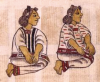
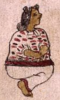
This iconographic example of a woman who had the title “doña” (“lady”). This title entered Nahuatl as a loanword from Spanish. The lady pictured here was the wife of don Diego Tlilpotonqui, a ruler in the Tepetlaoztoc area (spelled Tepetlaoxtoc today). She is glossed as “doña gathelina,” but someone later changed the g to C. She wears her hair in the adult woman’s style called neaxtlahualli, which involves the hair being twisted up into two points above the forehead. She also wears what are surely a huipilli (handwoven blouse) and cueitl (skirt) with special patterns and colors that were worthy of her elite status. Her seated posture is classic for women.
Stephanie Wood
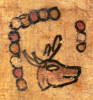
Men are far more prevalent in codices than women, and elite women are more likely to get into the historical record than poor rural women. In this collection, another woman of this higher social standing had the Nahuatl title cihuapilli (a noblewoman or a lady), which was paired in the gloss with her baptismal name, doña Catalina (just a coincidence). This Catalina was a woman who lived in the Mixteca, a region of what is now the state of Oaxaca (originally Huaxyacac). Her hairstyle is quite different from the Nahua woman’s hair in the image above. And yet another noblewoman who lived in the Mixteca, doña Lucia de León (also known as Matlactli Omei Mazatl, 13-Deer), dresses and wears her hair like a Nahua, as shown in the contextualizing image under her name glyph, below.
The Spanish baptismal names of the various Nahua women on this manuscript page proved a challenge for the tlacuilo. Besides “gathelina” (Catalina), we see “pedronilla” (Petronila), and “peatriz” (which someone later changed to “beatriz”). Of course, Spanish orthography was different in the 1550s, compared to what it is today. It was evolving, but patterns are nevertheless detectable.
Side Note: The folio numbers are not always clear in the copy published online by the British Museum. Marc Thouvenot gives this page the number K03_A in his TLACHIA digital collection, https://tlachia.iib.unam.mx/tepetlaoztoc/K03_A.
Stephanie Wood
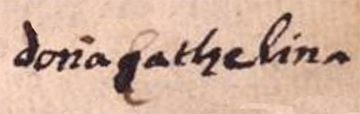
doña gathelina (and later doña Cathelina)
doña Catalina
Stephanie Wood
c. 1556
Jeff Haskett-Wood
mujer, mujeres, títulos sociales, jerarquía social, textiles, huipiles
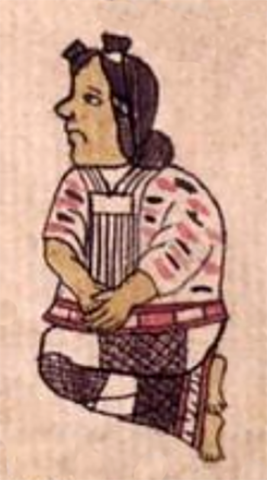
doña, a title for an elite woman, akin to “lady,” https://nahuatl.wired-humanities.org/content/doña
(el título de respeto para una mujer noble)
Stephanie Wood
The Codex Kingsborough, also known as the Códice de Tepetlaoztoc, and the Memorial de los indios de Tepetlaoztoc, is not on display. It was transferred from the British Library and is now held by the British Museum. It is shared on line at: https://www.britishmuseum.org/collection/object/E_Am2006-Drg-13964
©The Trustees of the British Museum. Shared under a Creative Commons Attribution-Non-Commercial-ShareAlike 4.0 International (CC BY-NC-SA 4.0) license. Please also cite the <em>Visual Lexicon of Aztec Hieroglyphsem>, ed. Stephanie Wood (Eugene, Ore.: Wired Humanities Projects, 2020-present) and this URL.