Coyotzinco (MH715v)
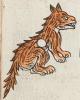
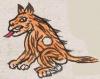
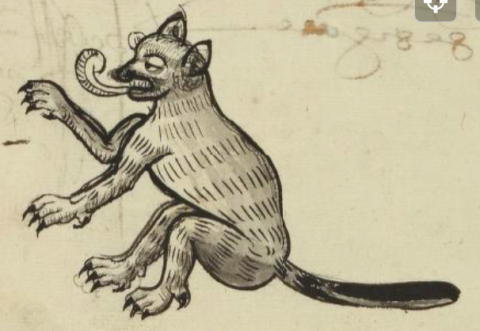
This black-line drawing of the compound Nahuatl hieroglyph for the place name, Coyotzinco (perhaps "New Coyotlan," shows a coyote (coyotl) in profile, facing toward the viewer’s left. The animal’s coat is elaborately textured and shaded, giving it a three-dimensional effect. It is in a seated position with its two front paws raised up. All four paws have sharp black claws. A speech scroll emerges from the animal’s mouth, a visual indicator that it may be growling. Its eye is open, and its teeth are showing.
Stephanie Wood
Somewhat more attention to the animal's rear end suggests an effort to point to the -tzinco suffix (from tzintli, buttocks).
Stephanie Wood

Coyotzinco.
Coyotzinco
1560
Jeff Haskett-Wood
coyotes, animals, nombres de lugares, pueblos, altepetl, place names, fonetismo, topónimos
coyo(tl), coyote, https://nahuatl.wired-humanities.org/content/coyotl
-tzinco, a spinoff community, https://nahuatl.wired-humanities.org/content/tzinco
Nuevo Coyotlan
Stephanie Wood
Matrícula de Huexotzinco, folio 715v, World Digital Library, https://www.loc.gov/resource/gdcwdl.wdl_15282/?sp=509&st=image
This manuscript is hosted by the Library of Congress and the World Digital Library; used here with the Creative Commons, “Attribution-NonCommercial-ShareAlike 3.0 License” (CC-BY-NC-SAq 3.0).