Cuauhxonecuilatl (Verg38v)
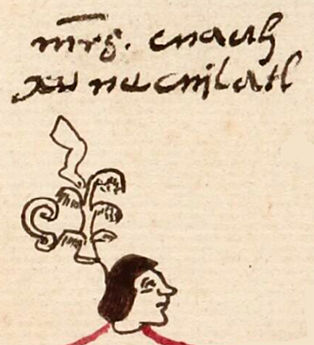
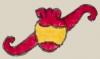
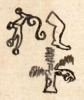
This compound Nahuatl hieroglyph is a black-line drawing of the personal name Cuauhxonecuilatl, a man’s name, which may refer to a type of tree (cuahuitl), a crooked stick, or a twisted leg. The largest element in the compound is a tree (cuahuitl), whose stem is Cuauh-, the start to the name. Above the tree is a provide view of a leg (providing the phonetic syllable -xo-, along with the possibility of a semantic contribution about a twisted leg). To the left is a curling shape (providing the phonetic syllable -cuil-) with a tiny head, perhaps of an animal, at the base of the curl. It is unclear whether the head makes either any phonetic or semantic contribution, but the curl seems to point to something twisted or bent. The -atl ending of the name does not have obvious visual representation, where one might expect a spray of water. Whether the name needs to include water or some type of liquid in the translation is unclear.
Stephanie Wood
This name is longer and more elaborate than any similar name in this collection. One name, Xonecuil, shows a full leg that may be twisted. Another Xonecuil name shows a zigzagging stick with a small feather at the top. The place name Yolloxonecuillan shows a heart and a curving staff (xonecuilli) that was apparently a type of religious offering.
Stephanie Wood
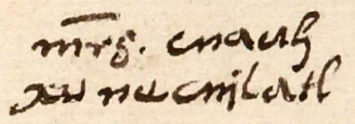
mrs. cuauhxonecuilatl
Marcos Cuauhxonecuilatl
Stephanie Wood
1539
Jeff Haskett-Wood
árboles, pierna, piernas, pie, pies, pluma, plumas, bastón, bastones, ofrenda, ofrendas, torcer, curvar, curvo, religión indígena, fonetismo, nombres de hombres, men’s names
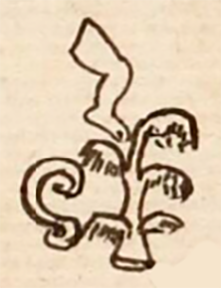
posiblemente, Árbol Torcido o Bastón Torcido de Madera (hecha para ofrendas)
Stephanie Wood
Available at Codex Vergara, folio 38v, https://gallica.bnf.fr/ark:/12148/btv1b84528032/f84.item.zoom, accessed 1 March 2026. The Vergara is associated with Tepetlaoztoc, in the larger region of Tetzcoco, c. 1539–1543. “Source gallica.bnf.fr / BnF.” We would also appreciate a citation to the Visual Lexicon of Aztec Hieroglyphs, https://aztecglyphs.wired-humanities.org/.
Image Rights: The non-commercial reuse of images from the Bibliothèque nationale de France is free as long as the user is in compliance with the legislation in force and provides the citation: “Source gallica.bnf.fr / Bibliothèque nationale de France” or “Source gallica.bnf.fr / BnF.” We would also appreciate a citation to the Visual Lexicon of Aztec Hieroglyphs, https://aztecglyphs.wired-humanities.org/