cueitl (TK217r)
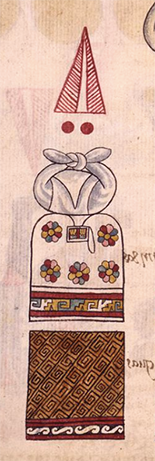
This painted example of iconography refers to a skirt (cueitl, in Nahuatl, but called “nahuas” in the Spanish-language gloss). It has a rectangular shape, and it is covered with a repeating rectangular spiral design. The background is brown and the spirals are drawn with black lines. They are placed between black lines that run on a diagonal. There are at least nine rows of spirals across the skirt. Below this are some red and black horizontal stripes with one row of white S-shapes lying on their sides.
Stephanie Wood
The cueitl appears in many Nahuatl hieroglyphs, often as an element in a personal name and typically names held by men. This may surprise those who know that a woman was sometimes called a “skirt.” The cueitl will have many different designs, but the lower part usually has a pattern in the shape of a border.
Side Note: The folio numbers are not always clear in the copy published online by the British Museum. Marc Thouvenot gives this page the number K15_A in his TLACHIA digital collection, https://tlachia.iib.unam.mx/tepetlaoztoc/K15_A.
Stephanie Wood
c. 1556
Jeff Haskett-Wood
coil, coils, step fret, stepped
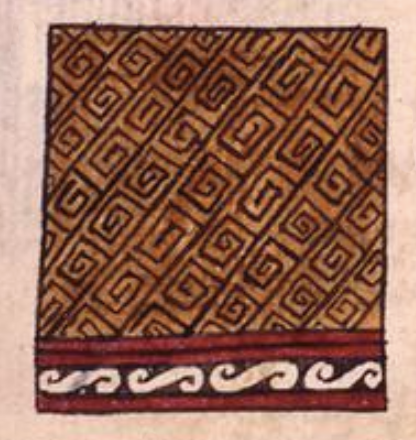
cue(itl), a skirt, https://nahuatl.wired-humanities.org/content/cueitl
la falda, o las naguas
Stephanie Wood
The Codex Kingsborough, also known as the Códice de Tepetlaoztoc, and the Memorial de los indios de Tepetlaoztoc, is not on display. It was transferred from the British Library and is now held by the British Museum. It is shared on line at: https://www.britishmuseum.org/collection/object/E_Am2006-Drg-13964
©The Trustees of the British Museum. Shared under a Creative Commons Attribution-Non-Commercial-ShareAlike 4.0 International (CC BY-NC-SA 4.0) license. Please also cite the <em>Visual Lexicon of Aztec Hieroglyphsem>, ed. Stephanie Wood (Eugene, Ore.: Wired Humanities Projects, 2020-present) and this URL.