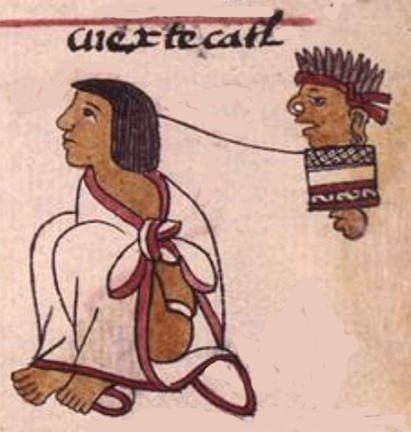
Cuextecatl (TK207v)
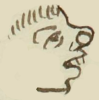
This painted compound Nahuatl hieroglyph represents the personal name or ethnicity Cuextecatl, associated with the Huasteca region of Mexico. The compound seems to have three elements, read in a downward direction. At the top is the head of a man in profile, looking left. He wears a gray feathered headdress with a red tie at the back of his head. His mouth is slightly open and he has a nose ornament. Below his chin is a rectangular textile with horizontal stripes in red, gray, and white. From top to bottom, the stripes are as follows: a mesh pattern with diamonds with dots in the middle, a plain white band, a plain red band, a stripe with S-shapes lying horizontally. This textile might be a skirt (cueitl), perhaps with the intention of providing a phonetic syllable -cue-. If so, it would be the first to enter this collection. Finally, at the lower end of the compound is the lower part of a human face in profile, facing left, and supplying the phonetic syllable -te- from tentli (lips) to introduce the final affiliation suffix, -tecatl.
Stephanie Wood
Several glyphs in this collection for Cuextecatl (below) show the head of a man with the same nose ornament. The likelihood that this is an ethnic marker seems great. Another Cuextecatl (also below) wears the regalia for the warrior who was called a Cuextecatl. The fabric rectangle shown in this compound, however, is not echoed in that regalia, which may therefore push this textile more toward being a skirt–and a phonetic syllable.
Side Note: The folio numbers are not always clear in the copy published online by the British Museum. Marc Thouvenot gives this page the number K05_B in his TLACHIA digital collection, https://tlachia.iib.unam.mx/tepetlaoztoc/K05_B.
Stephanie Wood
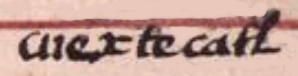
Cuextecatl (or Huaxtecatl)
Stephanie Wood
c. 1556
Jeff Haskett-Wood
etnicidad tocado emplumado, tocados, penacho, penachos, falda, naguas, textiles, tela a rayas, labios, nombres de hombres, men’s names, fonetismo
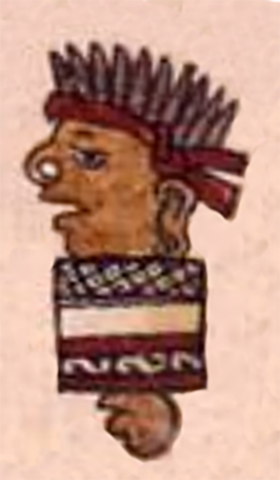
cuexteca(tl), an ethnicity associated with the Huasteca, https://nahuatl.wired-humanities.org/content/cuextecatl
-tecatl, affiliation suffix relating to place, https://nahuatl.wired-humanities.org/content/tecatl
ten(tli), lips, https://nahuatl.wired-humanities.org/content/tentli
The Codex Kingsborough, also known as the Códice de Tepetlaoztoc, and the Memorial de los indios de Tepetlaoztoc, is not on display. It was transferred from the British Library and is now held by the British Museum. It is shared on line at: https://www.britishmuseum.org/collection/object/E_Am2006-Drg-13964
©The Trustees of the British Museum. Shared under a Creative Commons Attribution-Non-Commercial-ShareAlike 4.0 International (CC BY-NC-SA 4.0) license. Please also cite the <em>Visual Lexicon of Aztec Hieroglyphsem>, ed. Stephanie Wood (Eugene, Ore.: Wired Humanities Projects, 2020-present) and this URL.