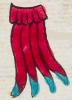
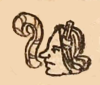
Cuitlapil (Verg29r)
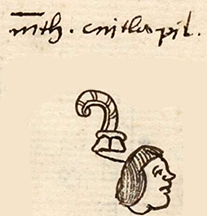
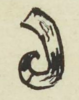
This compound Nahuatl hieroglyph is a black-line drawing of the personal name Cuitlapil (“Animal Tail”), attested here as a man’s name. It shows a segmented or striped object (a cuitlapil, a tail, perhaps a ringtail) curling to the left. At its base are two front teeth (tlantli), which serve as a phonetic complement to the -tla- part of the name. Another very similar Cuitlapil compound hieroglyph appears on folio 31 verso. Animal tails with rings are found on raccoons, monkeys, coatis, and lemurs, for example.
Stephanie Wood
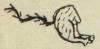
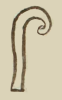
Cuitlapil is a name found across regions, such as in the Matrícula de Huexotzinco. A bird’s tail also appears in this collection as a part of a place name in the Codex Mendoza. The iconography of the Cuitlapil is much like the volute as drawn for Cihuacuicatl (Verg33r).
Stephanie Wood
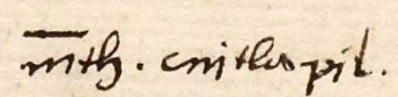
mth. cuitlapil.
Matheo (Mateo) Cuitlapil
Stephanie Wood
1539
Jeff Haskett-Wood
colas, cola rizada, dientes, nombres de hombres, fonetismo, nombres de hombres, men’s names
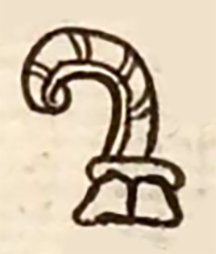
cuitlapil, animal tail, https://nahuatl.wired-humanities.org/content/cuitlapilli
la cola de un animal
Stephanie Wood
Available at Codex Vergara, folio 29r, https://gallica.bnf.fr/ark:/12148/btv1b84528032/f65.item.zoom, accessed 22 February 2026. The Vergara is associated with Tepetlaoztoc, in the larger region of Tetzcoco, c. 1539–1543.
“Source gallica.bnf.fr / BnF.” We would also appreciate a citation to the Visual Lexicon of Aztec Hieroglyphs, https://aztecglyphs.wired-humanities.org/.
Image Rights: The non-commercial reuse of images from the Bibliothèque nationale de France is free as long as the user is in compliance with the legislation in force and provides the citation: “Source gallica.bnf.fr / Bibliothèque nationale de France” or “Source gallica.bnf.fr / BnF.” We would also appreciate a citation to the Visual Lexicon of Aztec Hieroglyphs, https://aztecglyphs.wired-humanities.org/