Cihuacuicatl (Verg33v)
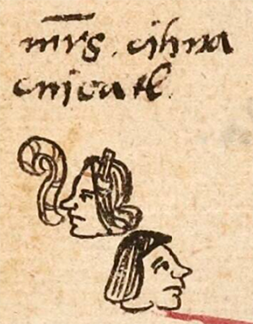
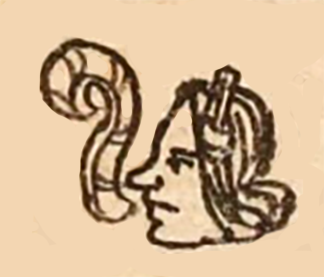
This compound Nahuatl hieroglyph is a black-line drawing of the personal name Cihuacuicatl (“Woman Song”). It shows the head of an adult woman (cihuatl) wearing the neaxtlahualli or axtlahuilli hairstyle. She is shown in profile, facing left. Curling out of her mouth is a segmented volute representing song (cuicatl). This is apparently a name that refers to “Woman-Song” or the “Song of Women.” Another nearly identical glyph for Cihuacuicatl appears on folio 36 recto.
Stephanie Wood
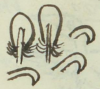
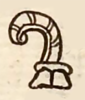
This one here is the first Cihuacuicatl to enter this digital collection (March 2026), but cuicatl is well represented, as is cihuatl. Volutes that represent songs are sometimes more elaborate than simple scrolls representing speech, as in the example from the Codex Mendoza. But song volutes can look just like speech, as in the example from Tozcuica (MH523v). Funnily enough, the iconography of this woman-song is almost identical to the animal tail in the compound personal name Cuitlapil (below). Another Cihuacuicatl compound hieroglyph, just like the one here, appears on folio 36 recto.
Stephanie Wood
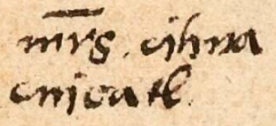
mrs. cihuacuicatl.
Marcos Cihuacuicatl
Stephanie Wood
1539
Jeff Haskett-Wood
canciones, volutas
cihua(tl), woman, https://nahuatl.wired-humanities.org/content/woman
cuica(tl), song, singing, music, https://nahuatl.wired-humanities.org/content/cuicatl
Mujer-Canción, o la Canción de las Mujeres
Stephanie Wood
Available at Codex Vergara, folio 33v, https://gallica.bnf.fr/ark:/12148/btv1b84528032/f74.item.zoom, accessed 1 March 2026. The Vergara is associated with Tepetlaoztoc, in the larger region of Tetzcoco, c. 1539–1543. “Source gallica.bnf.fr / BnF.” We would also appreciate a citation to the Visual Lexicon of Aztec Hieroglyphs, https://aztecglyphs.wired-humanities.org/.
Image Rights: The non-commercial reuse of images from the Bibliothèque nationale de France is free as long as the user is in compliance with the legislation in force and provides the citation: “Source gallica.bnf.fr / Bibliothèque nationale de France” or “Source gallica.bnf.fr / BnF.” We would also appreciate a citation to the Visual Lexicon of Aztec Hieroglyphs, https://aztecglyphs.wired-humanities.org/