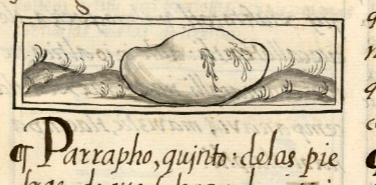
eztetl (FCbk11f209v)
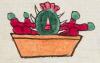
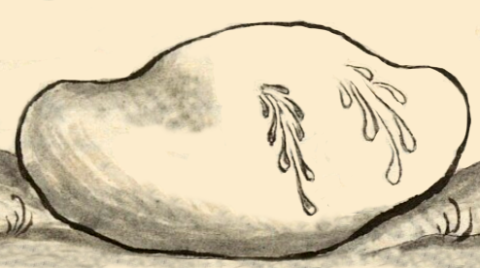
This compound hieroglyph features a bloodstone (eztetl). It is included in this digital collection for the purpose of making comparisons with related hieroglyphs. The term selected for this example comes from the text near the image in the Digital Florentine Codex. There is no gloss, per se. This example shows a stone (tetl) that is shaped like a potato, made three-dimensional with shading, a European artistic innovation for Nahua tlacuilos. The bloodstone, which is called this because of being “mottled like blood” (in the Anderson and Dibble translation), actually shows blood dripping down the outside of the stone in two places rather than having spots. The representation of the blood does not have the stylistics of earlier hieroglyphs of liquids, but looks more like drops of blood that might be drawn by a European artist, such as on a painting of Christ. This is true, too, of the way the general shape of stone appears, very unlike early hieroglyphs of stones, which have wavy diagonal lines and curling ends. Putting the stone in a landscape setting also reflects European artistic influences.
Stephanie Wood
This is the first bloodstone (eztetl) to enter this digital collection (as of December 2025), but stones and blood are represented in the collection.
Stephanie Wood
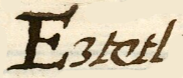
Eztetl
eztetl
Stephanie Wood
1577
Jeff Haskett-Wood
piedras, gotas de sangre, paisaje
ez(tli), blood, https://nahuatl.wired-humanities.org/content/eztli
te(tl), stone or gem, https://nahuatl.wired-humanities.org/content/tetl
la piedra de sangre
Stephanie Wood
Available at Digital Florentine Codex/Códice Florentino Digital, edited by Kim N. Richter and Alicia Maria Houtrouw, "Book 11: Earthly Things", fol. 209v, Getty Research Institute, 2023. https://florentinecodex.getty.edu/en/book/11/folio/209v/images/0 Accessed 16 November 2025.
Images of the digitized Florentine Codex are made available under the following Creative Commons license: CC BY-NC-ND (Attribution-NonCommercial-NoDerivs 4.0 International). For print-publication quality photos, please contact the Biblioteca Medicea Laurenziana ([email protected]). The Library of Congress has also published this manuscript, using the images of the World Digital Library copy. “The Library of Congress is unaware of any copyright or other restrictions in the World Digital Library Collection. Absent any such restrictions, these materials are free to use and reuse.”