huexolotl (FCbk11f56v)
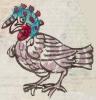
This iconographic example, featuring a male turkey (huexolotl, or huehxolotl, with the glottal stop), is included in this digital collection for the purpose of making comparisons with related hieroglyphs. The term selected for this example comes from the Nahuatl text near the image in the Digital Florentine Codex. There is no gloss, per se. This example shows a standing turkey in profile, facing left, with its right leg raised as though it is walking (in movement). It has a red, wrinkled snood protruding above its beak, and a long red wattle below. Its head and neck have red and turquoise blue spots on a white base, but the rest of the turkey has black, gray, and white feathers. It appears to wear a necklace with large red and blue beads and a row of smaller beads above that. Perhaps this necklace is symbolic of the caruncles that turkeys have naturally.
Stephanie Wood
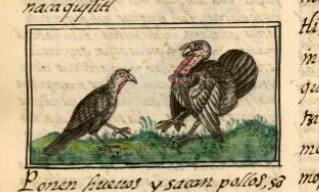
The huexolotl was a tribute item, enjoyed for its supply of a substantial amount of meat when compared to other birds. The totolin could be a turkey hen, but James Lockhart argues that it could be male or female. In the contextualizing image here, the huexolotl appears to be male and his companion (less showy and therefore better able to protect the nest) probably female. In this digital collection, the totolin is far more common than the huexolotl.
Stephanie Wood
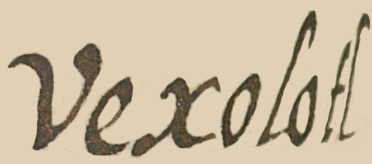
vexolotl
huexolotl
Stephanie Wood
1577
Jeff Haskett-Wood
gallos, guajolotes, ave, aves, comida, carne de pavo
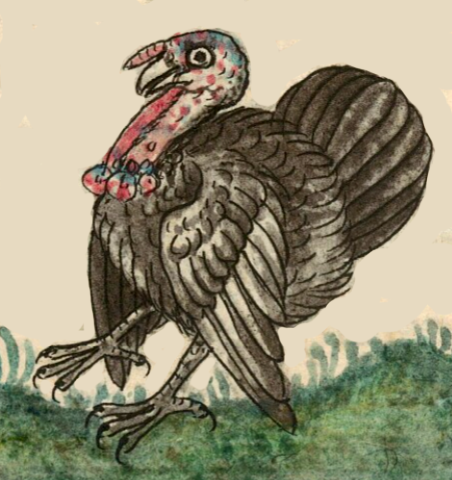
huexolo(tl), tom turkey or turkey cock, https://nahuatl.wired-humanities.org/content/huexolotl
el gallo de pavo, o el guajolote
Stephanie Wood
Available at Digital Florentine Codex/Códice Florentino Digital, edited by Kim N. Richter and Alicia Maria Houtrouw, "Book 11: Earthly Things", fol. 56v, Getty Research Institute, 2023. https://florentinecodex.getty.edu/en/book/11/folio/56v/images/0 Accessed 16 October 2025.
Images of the digitized Florentine Codex are made available under the following Creative Commons license: CC BY-NC-ND (Attribution-NonCommercial-NoDerivs 4.0 International). For print-publication quality photos, please contact the Biblioteca Medicea Laurenziana ([email protected]). The Library of Congress has also published this manuscript, using the images of the World Digital Library copy. “The Library of Congress is unaware of any copyright or other restrictions in the World Digital Library Collection. Absent any such restrictions, these materials are free to use and reuse.”