Icnonemitl (Verg24r)
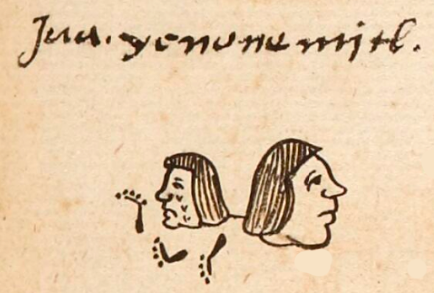
This compound Nahuatl hieroglyph is a black-line drawing of a man’s head in profile, facing left, with tears coming down his visible cheek. Three footprints going in different directions appear below this head (not the tribute payer’s own head) suggesting that the subject of the name may be aimless. Icnonemitl may be the individual’s personal name or his status.
Stephanie Wood
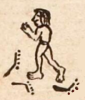
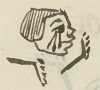
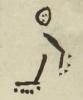
Icnonemitl also appears in the Matrícula de Huexotzinco with the same ambiguity as to name or status. See below. Another Icnonemitl that combines footprints with the head of an older man can be found on folio 26 recto of the Codex Vergara.
Stephanie Wood

jua.ycnonemitl
Juan Icnonemitl
Stephanie Wood
1539
Jeff Haskett-Wood
humildad, pobreza, orfandad, nombres de hombres, men’s names
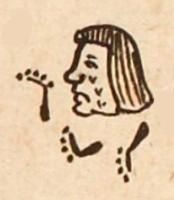
icnonemi(tl), one who lives humbly or like an orphan, https://nahuatl.wired-humanities.org/content/icnonemitl
posiblemente, “Él Que Vive Como Huérfano”
Stephanie Wood
Available at Codex Vergara, folio 24r, https://gallica.bnf.fr/ark:/12148/btv1b84528032/f55.item.zoom , accessed 22 February 2026. The Vergara is associated with Tepetlaoztoc, in the larger region of Tetzcoco, c. 1539–1543.
The non-commercial reuse of images from the Bibliothèque nationale de France is free as long as the user is in compliance with the legislation in force and provides the citation: “Source gallica.bnf.fr / Bibliothèque nationale de France” or “Source gallica.bnf.fr / BnF.” We would also appreciate a citation to the Visual Lexicon of Aztec Hieroglyphs, https://aztecglyphs.wired-humanities.org/.