icpacxochitl (FCbk11f198v)
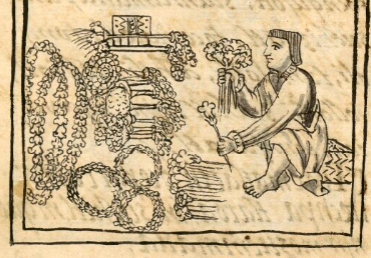
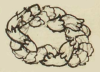
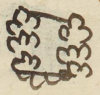
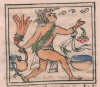
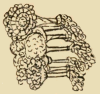
This iconographic example, featuring a flower garland or crown (icpacxochitl), is included in this digital collection for the purpose of making comparisons with related hieroglyphs. The term selected for this example comes from the text near the image in the Digital Florentine Codex. There is no gloss, per se. This example shows a black-line drawing in a frontal view of two long flower garlands that look much like Polynesian leis. The string with which the flowers were strung is visible here and there. The text also speaks of threading and stringing flowers. The garland on the left is cut off a bit by what was a box around it, which did not allow the tlacuilo enough space to finish that one. The contextualizing image shows shorter flower crowns lying on the ground next to the long ones. Other items made by flower workers shown in this context include a flower necklace (suchicozcatl, i.e., xochicozcatl), a paper of flowers (suchiamatl, i.e., xochiamatl), bouquets (tlatlanecutli, or tlatlanecuhtli), hand flowers (macsuchitl, i.e., macxochitl), and flower shields (chimalsuchitl, i.e., chimalxochitl).
Stephanie Wood
Nahuas adorned their divine forces with flower garlands. Such flowers were also important in ceremonial offerings, served as gifts to guests during feasts, and some were put onto people designated for sacrifice. [See: Frances Berdan, The Aztecs, 2021, 169; Jennifer Kathleen Browder, “Place of the High Painted Walls,” Ph.D. Dissertation, UC Riverside, 2005, 163; Susan Toby Evans and David L. Webster, Archaeology of Ancient Mexico and Central America, 2001, 272; Steven Buchmann, The Reason for Flowers, 2015, 94.] The image on folio 199r shows that men wore the garland across their bodies (over the head and over one shoulder). The crowns went around the head at the height of the forehead, and they were tied at the back with flowers trailing down to the height of their shoulders. In one hieroglyph in this collection, Tocpacxochiuh (“Our Flower Crown”) is a Nahua man’s personal name (see below). Other hieroglyphs show flower garlands that are part of various semantic compositions. For example, the iconographic example of the tlahuanqui (drunk man), shows him wearing flowers on his head, even if his is not quite a garland or crown of flowers.
Stephanie Wood
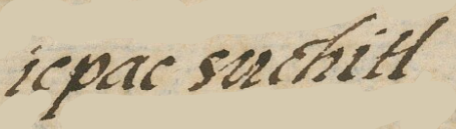
icpac suchitl
icpacxochitl
Stephanie Wood
1577
Jeff Haskett-Wood
guirnaldas, flores ensartadas, cadena de flores, cadenas, flor, arreglo floral
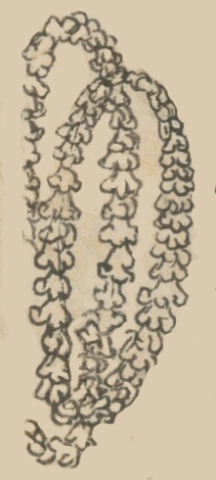
icpacxoch(itl), flower garland, https://nahuatl.wired-humanities.org/content/icpacxochitl
la guirnalda de flores
Stephanie Wood
Available at Digital Florentine Codex/Códice Florentino Digital, edited by Kim N. Richter and Alicia Maria Houtrouw, "Book 11: Earthly Things", fol. 198v, Getty Research Institute, 2023. https://florentinecodex.getty.edu/en/book/11/folio/198v/images/0 Accessed 16 November 2025.
Images of the digitized Florentine Codex are made available under the following Creative Commons license: CC BY-NC-ND (Attribution-NonCommercial-NoDerivs 4.0 International). For print-publication quality photos, please contact the Biblioteca Medicea Laurenziana ([email protected]). The Library of Congress has also published this manuscript, using the images of the World Digital Library copy. “The Library of Congress is unaware of any copyright or other restrictions in the World Digital Library Collection. Absent any such restrictions, these materials are free to use and reuse.”