Itzcuincuitlapilco (Mdz8r)
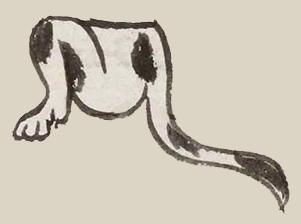
This simplex glyph for the place name Itzcuincuitlapilco can also serve to represent the itzcuintli dog or its tail (cuitlapilli). It is only half a dog, the lower half. It is shown in profile, sitting, facing toward the viewer's left, with a long tail on the right. It is largely white, but with some black spots.
Stephanie Wood
Este glifo simple para el topónimo Itzcuincuitlapilco puede también fungir como una representación del perro itzcuintli o de su cola (cuitlapilli). Se aprecia únicamente la mitad inferior del cuerpo del can, sentado y de perfil, apuntando hacia la izquierda del espectador y con el rabo largo hacia la dirección contraria. Su pelaje es blanco con algunas manchas negras.
The bodily position of the dog speaks to cuitlatl (excrement), and attention is drawn to the animal's tail (cuitlapilli). The itzcuintli is, incidentally, a day sign in the calendar.
Stephanie Wood
La posición del perro indica el cuitlatl (excremento) y se llama la atención sobre la cola (itzcuintli) del animal. Recuérdese que el itzcuintli era también un signo de día calendárico.
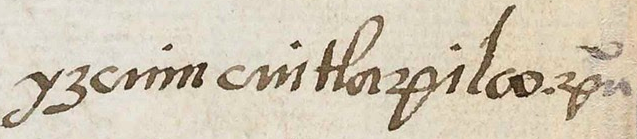
Stephanie Wood
c. 1541, or by 1553 at the latest
Stephanie Wood
nombres de lugares
itzcuin(tli), dog, https://nahuatl.wired-humanities.org/content/itzcuintli
cuitlapil(li), tail, https://nahuatl.wired-humanities.org/content/cuitlapilli
-co (locative suffix), in or at, https://nahuatl.wired-humanities.org/content/co
Codex Mendoza, folio 8 recto, https://digital.bodleian.ox.ac.uk/objects/2fea788e-2aa2-4f08-b6d9-648c00..., image 26, of 188.
The Bodleian Libraries, University of Oxford, hold the original manuscript, the MS. Arch. Selden. A. 1. This image is published here under the UK Creative Commons, “Attribution-NonCommercial-ShareAlike 3.0 License” (CC-BY-NC-SA 3.0).