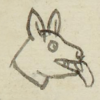
itzcuintli (Mdz8r)
This simplex Nahuatl hieroglyph for a dog (itzquintli) also represents the place name, Izcuincuitlapilco. It is only half a dog, the lower half. It is shown in profile, sitting, facing toward the viewer's left, with a long tail on the right. It is largely white, but with some black spots.
Stephanie Wood
Este jeroglífico simple náhuatl para la palabra “perro” (itzcuintli) también representa el topónimo Itzcuincuitlapilco. Se aprecia únicamente la mitad inferior del cuerpo del can, sentado y de perfil, apuntando hacia la izquierda del espectador y con el rabo largo hacia la dirección contraria. Su pelaje es blanco con algunas manchas negras.
Itzcuintli is a day sign in the 260-day religious divinatory calendar called the tonalpohualli, so it also appears in many personal name glyphs. Here, the focus on the dog's rear end has more to do with the place name, which mentions excrement, than anything about the basic nature of an itzquintli or its place in the calendar.
Stephanie Wood
El itzcuintli era un signo de día en el tonalpohualli, el calendario religioso-adivinatorio de 260 días, por lo que aparece frecuentemente como parte de glifos de nombres propios. En el presente ejemplo, la atención a la parte trasera del perro se relaciona sobre todo con el topónimo (el cual menciona el excremento), en vez de con la naturaleza fundamental de un itzcuintli o con su posición en el calendario.
Stephanie Wood
c. 1541, but by 1553 at the latest
Stephanie Wood
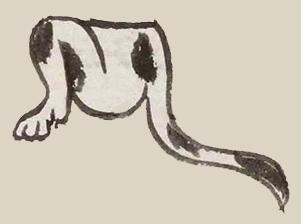
itzcuin(tli), dog, https://nahuatl.wired-humanities.org/content/itzcuintli
dog
Stephanie Wood
Codex Mendoza, folio 8 recto, https://digital.bodleian.ox.ac.uk/objects/2fea788e-2aa2-4f08-b6d9-648c00..., image 25, of 188.
The Bodleian Libraries, University of Oxford, hold the original manuscript, the MS. Arch. Selden. A. 1. This image is published here under the UK Creative Commons, “Attribution-NonCommercial-ShareAlike 3.0 License” (CC-BY-NC-SA 3.0).