Malintzin (FCbk12f13v)
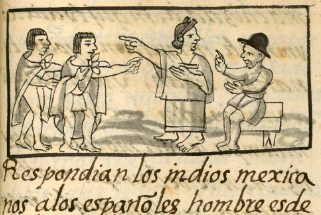
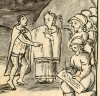
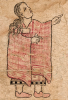
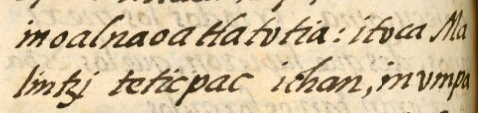
This iconographic example, featuring a black and white sketch of the Indigenous woman baptized as doña Marina (which was then Nahuatlized as Malintzin and reinterpreted back into Spanish as Malinche) doing the work of interpreting, is included in this digital collection for the purpose of making comparisons with related hieroglyphs. The term selected for this example comes from the text on the page preceding the image in the Digital Florentine Codex. There is no gloss, per se. This example shows the famous female interpreter standing between Cortés, seated in a three-quarters profile view, facing left, and seated on a bench with legs. He wears a black bolero had and a belted tunic, maybe with leggings. He gestures with both hands, but pointing with the index finger on his right hand. Perhaps surprisingly, in this scene there are no speech scrolls. Malintzin also gestures with both hands back toward the two Nahua men. She also points with her right index finger. The Nahua men are also gesturing and pointing. They wear cloaks tied on their shoulders and loincloths. Malintzin wears a huipilli blouse with a rectangular patch on her chest and a long skirt with a border at the bottom. Her hair is twisted into two points above her forehead, in what is called the neaxtlahualli or axtlahuilli hairstyle for adult women. The Nahuatl text explains how she translated into Nahuatl everything that Cortés said in Spanish. Her home is said to be in Teticpac. This scene is set in a simple landscape, and the textiles are shaded to give them three-dimensionality, both being traits learned by the tlacuilos from colonial art instructors.
Stephanie Wood
More details appear in the text than earlier in this book when she is mentioned. But just like earlier, she is acting alone in the interpreter position, with no sign of the other Spaniard (Jerónimo de Aguilar) who originally played a role, too.
Stephanie Wood
Malintzi
Mallintzin (a.k.a. doña Marina)
Stephanie Wood
1577
Jeff Haskett-Wood
interpretar, traducir, idiomas, languages, interpret, interpreting, interpretation, malpihuia
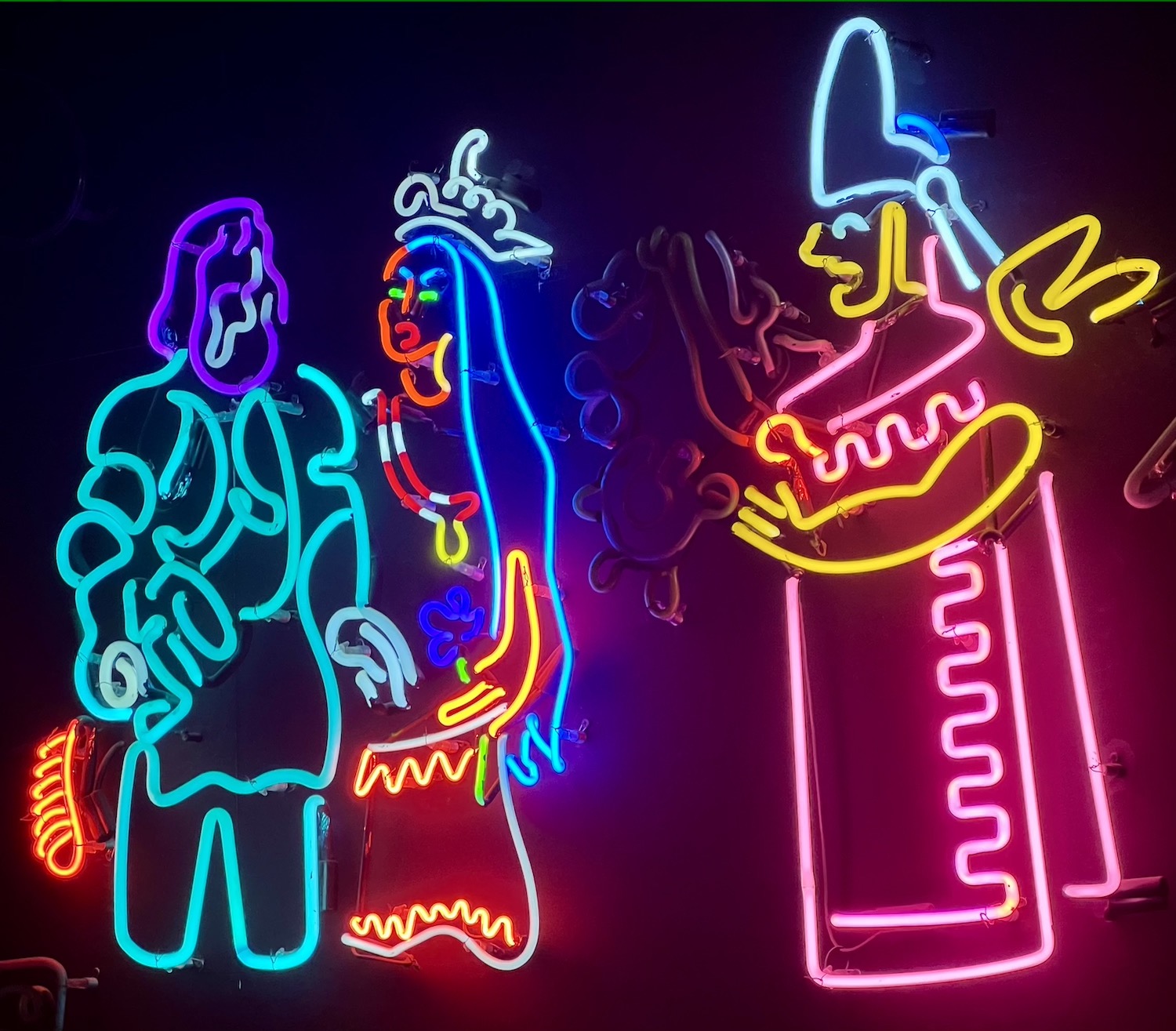
This detail in neon is part of a larger installation, “Cuenca del Anahuac” (2015), by César Moheno and Alejandro Salafranca at the Museo de la Ciudad de México. The artists incorporate what they call “pictografías” and other symbols from deep in Mexican history up to contemporary times. This one is a scene where doña Marina (Nahuatlized as Malintzin) interprets an exchange between Hernando Cortés and Motecuhzoma. Photograph by Stephanie Wood, 6 February 2026.
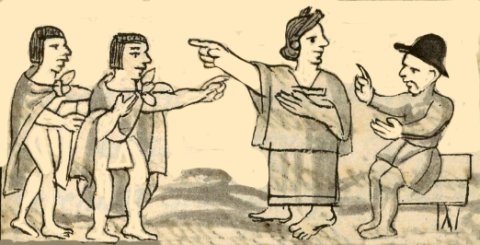
Marina, Nahua interpreter to Cortés, https://nahuatl.wired-humanities.org/content/Marina
La Malinche
Stephanie Wood
Available at Digital Florentine Codex/Códice Florentino Digital, edited by Kim N. Richter and Alicia Maria Houtrouw, "Book 12: Conquest of Mexico", fol. 13v, Getty Research Institute, 2023. https://florentinecodex.getty.edu/en/book/12/folio/13v/images/0 Accessed 7 February 2026.
Images of the digitized Florentine Codex are made available under the following Creative Commons license: CC BY-NC-ND (Attribution-NonCommercial-NoDerivs 4.0 International). For print-publication quality photos, please contact the Biblioteca Medicea Laurenziana ([email protected]). The Library of Congress has also published this manuscript, using the images of the World Digital Library copy. “The Library of Congress is unaware of any copyright or other restrictions in the World Digital Library Collection. Absent any such restrictions, these materials are free to use and reuse.”