Mihuacan (TK206v)
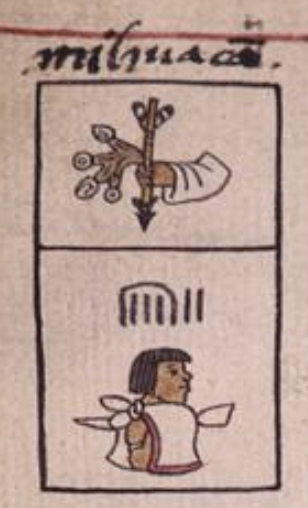
This black-line drawing of the compound Nahuatl hieroglyph for the place name Mihuacan (perhaps, “Place With Arrows”) is composed of three elements. The start of the name, Mi-, derives from the arrow (mitl) in the middle of the compound and with the point down. The possessive -hua- phonetic syllable comes from the grasping hand, which indicates possession. The little flow of water (atl) on the left side, with its lines of current and alternating droplets or beads and turbinate shells at the tips of the diverging sprays, underscores the presence of an “a” vowel, which could point to the -can locative suffix. It is worth noting that the grasping hand emerges from a sleeve that has lines giving it a three-dimensionality.
Stephanie Wood
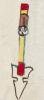
While many sources translate mitl as “dart” in this digital collection objects that look more like arrows dominate the visuals. See some examples below. Also, Alfonso Lacadena (PARI Journal, 2008) should be credited with noting the “grasping hand” as representative of a “hua” syllable.
Side Note: The folio numbers are not always clear in the copy published online by the British Museum. Marc Thouvenot gives this page the number K04_B in his TLACHIA digital collection, https://tlachia.iib.unam.mx/tepetlaoztoc/K04_B.
Stephanie Wood
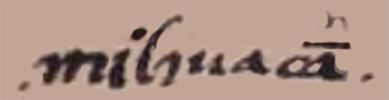
.mihuacā.
Mihuacan
Stephanie Wood
c. 1556
Jeff Haskett-Wood
flecha, arma, mano, agarrar, poseer, nombres de lugares, topónimo, topónimos, fonetismo
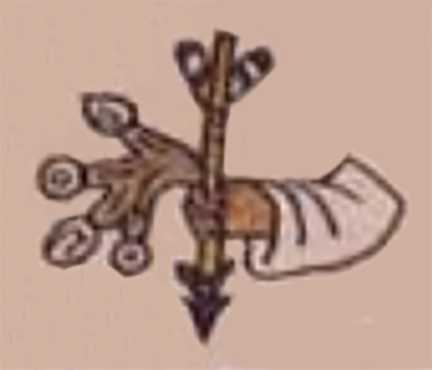
mi(tl), arrow or dart, https://nahuatl.wired-humanities.org/content/mitl
-hua, singular possessive, https://nahuatl.wired-humanities.org/content/hua
-can, locative suffix, where, https://nahuatl.wired-humanities.org/content/can-2
posiblemente, Lugar con Flechas
Stephanie Wood
The Codex Kingsborough, also known as the Códice de Tepetlaoztoc, and the Memorial de los indios de Tepetlaoztoc, is not on display. It was transferred from the British Library and is now held by the British Museum. It is shared on line at: https://www.britishmuseum.org/collection/object/E_Am2006-Drg-13964
©The Trustees of the British Museum. Shared under a Creative Commons Attribution-Non-Commercial-ShareAlike 4.0 International (CC BY-NC-SA 4.0) license. Please also cite the <em>Visual Lexicon of Aztec Hieroglyphsem>, ed. Stephanie Wood (Eugene, Ore.: Wired Humanities Projects, 2020-present) and this URL.