Motlahuizoma (MH633v)
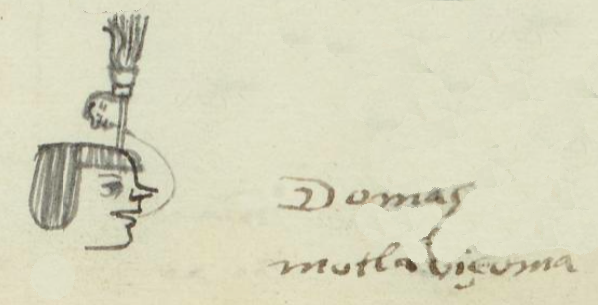
This black-line drawing of the compound glyph for the personal name Motlahuizoma is attested here as pertaining to a man. It has a construction much like the name Motecuhzoma, with a reflexive start that likely combines with the verb ending (-zoma, to frown and show anger). It may be that a noun intervenes between the Mo- and the -zoma. If so, perhaps it is tlahuitl, red ochre, which Frances Karttunen (see our Online Nahuatl Dictionary) says is indirectly attested in the verb tlahuia, having to do with "red firelight," or tlahuizcalli, the "rosy light of dawn." So, perhaps the name means "Angered by Red Firelight" or "Angry Like Red Fire"? The visuals include a man's head seemingly attached to a flaming torch.
Stephanie Wood
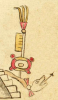
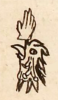
If the visual is not of a torch, perhaps it may be a red fan (see below). More research is merited. Also, the way the head faces down may suggest falling, perhaps pointing to the verb tlahuizoa.
Stephanie Wood

Domas
motlaviçoma
Tomas Motlahuizoma
Stephanie Wood
1560
Jeff Haskett-Wood
brillar, fruncir, cabeza, plumas, nombres de hombres, men's names, fonetismo
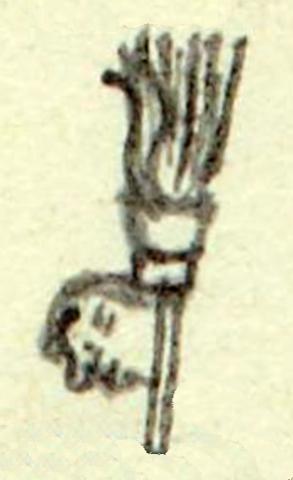
tlahuia, to light the way, https://nahuatl.wired-humanities.org/content/tlahuia
tlahuizoa, to let something fall, https://nahuatl.wired-humanities.org/content/tlahuizo%C4%81
zoma, to frown in anger, to become angry, https://nahuatl.wired-humanities.org/content/zoma
Matrícula de Huexotzinco, folio 633v, World Digital Library, https://www.loc.gov/resource/gdcwdl.wdl_15282/?sp=349st=image.
This manuscript is hosted by the Library of Congress and the World Digital Library; used here with the Creative Commons, “Attribution-NonCommercial-ShareAlike 3.0 License” (CC-BY-NC-SAq 3.0).