Nauhecatl (Verg41r)
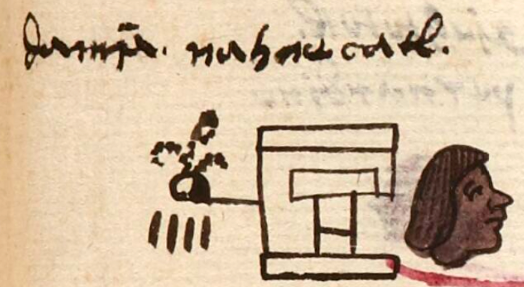
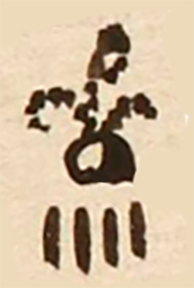
This compound Nahuatl hieroglyph is a black-line drawing of the personal name Nauhecatl (“Four-Wind”), which is attested here as a man’s name. It is a name that comes from the religious divinatory 260-day calendar, the tonalpohualli. It combines a day name (Ehecatl, referring to the divine force of the wind) with a number from 1 to 13, which is four (nahui) in this case. The stem for nahui is the first part of this name, Nauh-, which is shown visually with four short, vertical lines, a notation. The Ehecatl part of the name is typically shortened to -ecatl, without the reduplication at the beginning. A black bean (etl) with a white spot provides the phonetic syllable that indicates an E- is the start to this day sign. This is reinforced with swirling dots (perhaps dust) in swirling shapes, which helps to visualize the movement of the wind (ehecatl).
Stephanie Wood
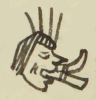
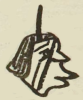
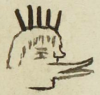
Seemingly in response to pressure from the colonial clergy to stop using the tonalpohualli for naming children, the companion numbers to the day names are often missing in hieroglyphs. But, here, we have the full name, Four-Wind. Several other examples of Four-Wind appear in this digital collection, along with other favorites, such as One-Wind and Five-Wind. See the visuals below, which typically reinforce the belief in a device worn on the face of a divine force through which to blow wind. Finally, another Nauhecatl appears in the Codex Vergara on folio 46 verso.
Stephanie Wood

damiā. nahuecatl.
Damian Nauhecatl
Stephanie Wood
1539
Jeff Haskett-Wood
frijol, frijoles, viento, aire, aliento, polvo, úmeros, cuatro, religión, calendario, tonalpohualli, nombres de hombres, men’s names
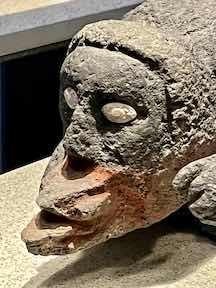
This is part of a pre-contact stone sculpture of Ehecatl with a focus on the wind-blowing device. Photograph by Stephanie Wood, Museo Nacional de Antropología e Historia, Mexico City, 14 February 2023.
nahui, four, https://nahuatl.wired-humanities.org/content/nahui
eca(tl), air or breath, https://nahuatl.wired-humanities.org/content/ecatl
eheca(tl), the wind, https://nahuatl.wired-humanities.org/content/ehecatl
Cuatro-Viento, o 4-Viento
Stephanie Wood
Available at Codex Vergara, folio 41r, https://gallica.bnf.fr/ark:/12148/btv1b84528032/f89.item.zoom, accessed 14 March 2026. The Vergara is associated with Tepetlaoztoc, in the larger region of Tetzcoco, c. 1539–1543. “Source gallica.bnf.fr / BnF.” We would also appreciate a citation to the Visual Lexicon of Aztec Hieroglyphs, https://aztecglyphs.wired-humanities.org/.
Image Rights: The non-commercial reuse of images from the Bibliothèque nationale de France is free as long as the user is in compliance with the legislation in force and provides the citation: “Source gallica.bnf.fr / Bibliothèque nationale de France” or “Source gallica.bnf.fr / BnF.” We would also appreciate a citation to the Visual Lexicon of Aztec Hieroglyphs, https://aztecglyphs.wired-humanities.org/