Nezahual (Verg33v)
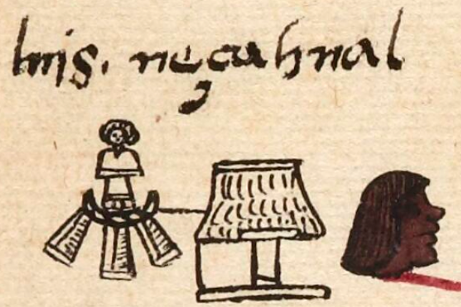
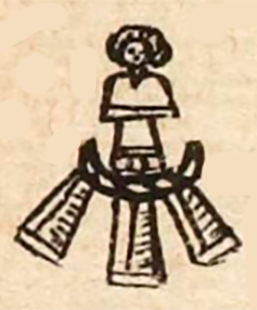
This compound Nahuatl hieroglyph is a black-line drawing of the personal name Nezahual (perhaps, “He Who Fasts”), attested here as a man’s name. The components, however, include a female figurine or doll (nenetl). But this provides the phonetic starting syllable, Ne-. Below the figurine is a cord for a necklace that suspends three shapes that are associated with the glyphs in the Florentine Codex for Nezahualcoyotl (“Fasting Coyote,” Tlatoani of Tetzcoco, 1431–1472)) and Nezahualpilli (“Fasting Noble,” Tlatoani of Tetzcoco, 1472–1515), two important names in Tetzcocan history. [See Bradley Benton, The Lords of Tetzcoco, 2017, 179.]
Stephanie Wood
Another Nezahualcoyotl in this collection shows bloodletting thorns; perhaps the shapes on the necklaces are the rectangular ends of the bloodletting devices, suggesting that the points are penetrating the neck (but out of sight, so less obviously related to bloodletting, which was discouraged by the colonial clergy). Other Nezahual compounds with the nenetl and necklace (of thorns?) appear in the Vergara on folio 35 recto and folio 37r.
Stephanie Wood
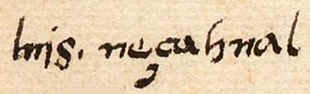
luis. neçahual
Luis Nezahual
Stephanie Wood
1539
Jeff Haskett-Wood
collar, collares, muñeca, muñecas, figurilla, figurillas, mujeres, nombres de hombres, fonetismo, men’s names
nezahual(li), a ritual fasting, abstinence, or maybe bloodletting, https://nahuatl.wired-humanities.org/content/nezahualli
nene(tl), a doll, a figurine, or a woman’s genitals, https://nahuatl.wired-humanities.org/content/nenetl
posiblemente, Ayunador
Stephanie Wood
Available at Codex Vergara, folio 33v, https://gallica.bnf.fr/ark:/12148/btv1b84528032/f74.item.zoom, accessed 1 March 2026. The Vergara is associated with Tepetlaoztoc, in the larger region of Tetzcoco, c. 1539–1543. “Source gallica.bnf.fr / BnF.” We would also appreciate a citation to the Visual Lexicon of Aztec Hieroglyphs, https://aztecglyphs.wired-humanities.org/.
Image Rights: The non-commercial reuse of images from the Bibliothèque nationale de France is free as long as the user is in compliance with the legislation in force and provides the citation: “Source gallica.bnf.fr / Bibliothèque nationale de France” or “Source gallica.bnf.fr / BnF.” We would also appreciate a citation to the Visual Lexicon of Aztec Hieroglyphs, https://aztecglyphs.wired-humanities.org/