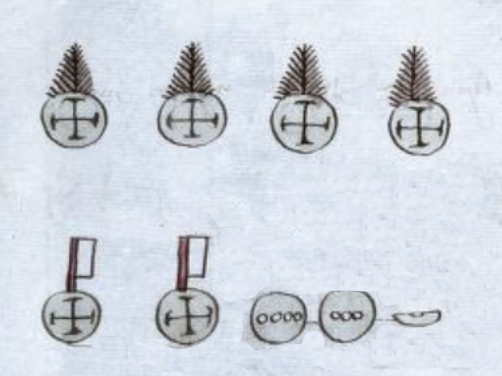
onpohualli pesos (Osu37r)
This is a notation and a simplex Nahuatl hieroglyph that is repeated twice. Each pair involves a peso coin (circular with a cross in the middle, washed with gray) and, standing on top of the coin, a rectangular white banner attached to a vertical brown stick. One peso with a flag on top equals 20 pesos, and when this is doubled, the result is 40 pesos, something of a math equation.
Stephanie Wood
The cross drawn on the peso is what might be called a potent or moline cross, something like a plus sign where each leg has a short perpendicular line at its end. The cross on the peso distinguishes it from a tomin, which is an eighth of a peso.
Stephanie Wood
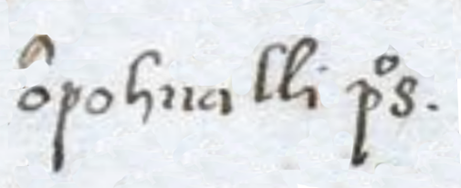
ōpohualli pos.
onpohualli pesos
Stephanie Wood
1551–1565
Jeff Haskett-Wood
pesos, cruz, cruces, banderas, números, notación, matemáticas, vigésimo, contar por veintes, coins, moneda, monedas, dinero

onpohual(li), forty, https://nahuatl.wired-humanities.org/content/onpohualli
peso, a piece of eight, https://nahuatl.wired-humanities.org/content/peso
cuarenta pesos
Stephanie Wood
Library of Congress Online Catalog and the World Digital Library, Osuna Codex, or Painting of the Governor, Mayors, and Rulers of Mexico, https://www.loc.gov/resource/gdcwdl.wdl_07324/. The original is located in the Biblioteca Nacional de España.
"The Library of Congress is unaware of any copyright or other restrictions in the World Digital Library Collection. Absent any such restrictions, these materials are free to use and reuse." But please cite the Biblioteca Nacional de España and this Visual Lexicon of Aztec Hieroglyphs if you use any of these images here or refer to the content on this page, providing the URL