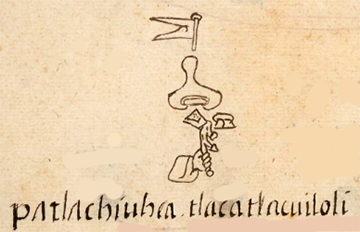
Patlachiuhcan (Verg33r)
This compound Nahuatl hieroglyph is a black-line drawing of the place name Patlachiuhcan. With six elements, it is an especially large compound. These elements start with a swallowtail flag (pamitl) flying left and having a cap at the top of the post. This flag is the phonetic indicator that the name starts with Pa-. Moving downward, the next element is a hill or mountain (tepetl) that narrows in the middle. This may be a semantic indicator that the compound represents a place name that has the locative -can (where). If the tepetl combines with the water (lower down) to create altepetl (town or city-state), that would also suffice to cover the -can semantically. Two front teeth (tlantli) stand for the -tla- syllable. The ear of corn and the hand with the water may provide for semantic meaning of chihua (to make or do), as in to perform agricultural work. The water (atl) could also provide a complementary -a- syllable, given that the vowel appears three times in the place name.
Stephanie Wood
Further research on this compound could help decipher it more satisfactorily. Two other appearances of the compound place name for this same community appear on folio 34 verso and 36 recto. They have the same elements, but in a different arrangement, nothing that helps clarify the interpretation. Next to the gloss for the place name in this example is another term worthy of study (tlacatlacuilolli), even if it is not expressed here in the compound hieroglyph. It refers to a demographic manuscript, and it is likely self-referential, given that this manuscript is a census of individuals, families, and their land parcels.
Stephanie Wood
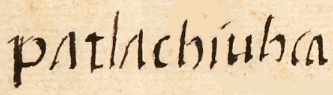
patlachiuhca
Patlachiuhcan
Stephanie Wood
1539
Jeff Haskett-Wood
6
agua, mano, barbilla y labios, maíz, tepetl, bandera, fonetismo
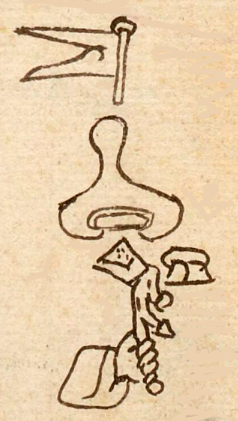
Patlachiuhcan, where there is a broad plain, https://nahuatl.wired-humanities.org/content/Patlachiuhcan
El Páramo
Stephanie Wood
Available at Codex Vergara, folio 33r, https://gallica.bnf.fr/ark:/12148/btv1b84528032/f73.item.zoom, accessed 1 March 2026. The Vergara is associated with Tepetlaoztoc, in the larger region of Tetzcoco, c. 1539–1543. “Source gallica.bnf.fr / BnF.” We would also appreciate a citation to the Visual Lexicon of Aztec Hieroglyphs, https://aztecglyphs.wired-humanities.org/.
Image Rights: The non-commercial reuse of images from the Bibliothèque nationale de France is free as long as the user is in compliance with the legislation in force and provides the citation: “Source gallica.bnf.fr / Bibliothèque nationale de France” or “Source gallica.bnf.fr / BnF.” We would also appreciate a citation to the Visual Lexicon of Aztec Hieroglyphs, https://aztecglyphs.wired-humanities.org/