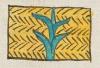
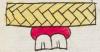
petlatl (TK204v)
This simplex Nahuatl hieroglyph shows a horizontal, rectagonal woven mat (petlatl). It is a golden/light brown color. This woven mat has numerous uses in Nahua society, such as for sleeping, sitting, wrapping corpses, and bundling loads being carried on one’s back.
Stephanie Wood
The weave here is less regular than in the normal petlatl glyph. See some examples below.
Side Note: The folio numbers are not always clear in the copy published online by the British Museum. Marc Thouvenot gives this page the number K02_B in his TLACHIA digital collection, https://tlachia.iib.unam.mx/tepetlaoztoc/K02_B.
Stephanie Wood
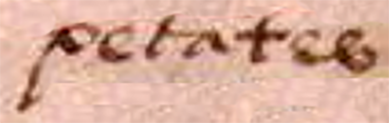
petates
(i.e., petlatl)
Stephanie Wood
c. 1556
Jeff Haskett-Wood
estera, esteras, tejida, tejidas, tejidos
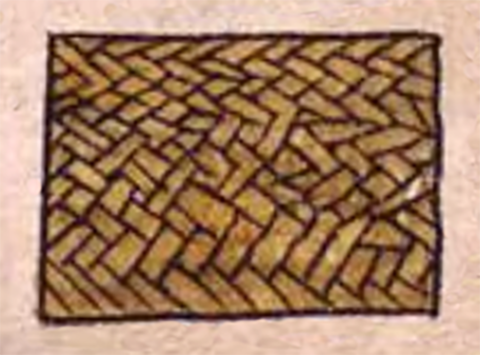
petla(tl), a woven mat, https://nahuatl.wired-humanities.org/content/petlatl
el petate
Stephanie Wood
The Codex Kingsborough, also known as the Códice de Tepetlaoztoc, and the Memorial de los indios de Tepetlaoztoc, is not on display. It was transferred from the British Library and is now held by the British Museum. It is shared on line at: https://www.britishmuseum.org/collection/object/E_Am2006-Drg-13964
©The Trustees of the British Museum. Shared under a Creative Commons Attribution-Non-Commercial-ShareAlike 4.0 International (CC BY-NC-SA 4.0) license. Please also cite the <em>Visual Lexicon of Aztec Hieroglyphsem>, ed. Stephanie Wood (Eugene, Ore.: Wired Humanities Projects, 2020-present) and this URL.