popolotza (FCbk12f26r)
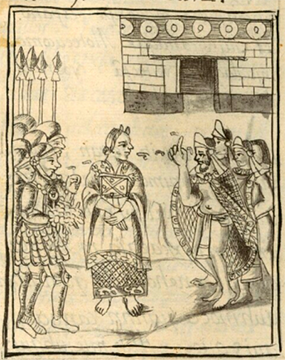
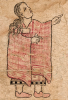
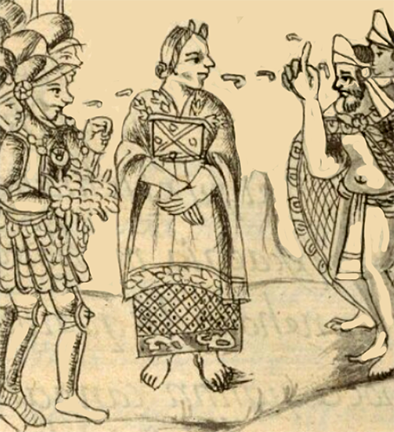
This is an iconographic example featuring a black and white sketch of Malintzin interpreting for Cortés and Motecuhzoma. In the Nahuatl text, Cortés is described as “replying in his babbling tongue” (popolotza). This conversation is included in this digital collection for the purpose of making comparisons with related hieroglyphs. The term selected for this example comes from the text near the image in the Digital Florentine Codex. There is no gloss, per se. This example shows Malintzin standing in a frontal view, her hands crossed in front of her abdomen. She wears an elaborate huipilli with a large rectangle over her chest with an X-shape that has dots in each of the four sections it creates. The huipilli has decorations on the shoulders and a border along the bottom edge. Her skirt also has a complicated weave that has diamond shapes with dotes in the middle of each diamond. Her hair is twisted up into the neaxtlahualli or axtlahuilli design of mature or married women. Cortés is on her left, facing right, and two speech scrolls indicate that he is speaking. Malintzin faces Motecuhzoma, who is on her right. She and he exchange two speech scrolls each. Motecuhzoma points his finger up in the air. He also wears a very elaborate cloak, also with a design of dotted diamOND shapes and a border of the tenixyo pattern (with eyes). The contextualizing image shows how each of these two leaders has a contingent of men with him. Cortés seems to carry a bouquet of flowers. The scene has some landscape features, including a place with a circular pattern below the roof, and some three-dimensionality. All this shows European artistic influence.
Stephanie Wood
This term derives from a history of interaction between Nahuas and Popolocas, whereby the latter were difficult for Nahuas to understand because of the Oto-Manguean language family. Popoloca can also be a synonym of popolotza. In this exchange, the Nahua tlacuilo seems to marvel over the way Cortés speaks, as though babbling. Regarding the fine textiles that appear here, it would seem that Malintzin was wearing a huipilli of the level of a lady (cihuapilli). As for Motecuhzoma’s elaborate cloak, compare it to the glyph below for the throne-like icpalli.
Stephanie Wood
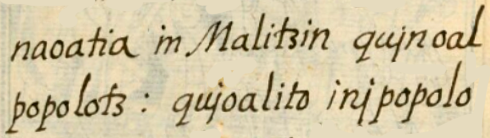
quinoalpopolotz
quinhualpopolotz
Stephanie Wood
1577
Jeff Haskett-Wood
hablar, conversación, interpretación, doña Marina, Malinche, españoles, Nahuas, parlotear, farfullar, Popolocas, etnicidad, etnicidades, mapilhuia
popolotza, to speak in an unintelligible way, to babble, https://nahuatl.wired-humanities.org/content/popolotza
balbucear
Stephanie Wood
Available at Digital Florentine Codex/Códice Florentino Digital, edited by Kim N. Richter and Alicia Maria Houtrouw, "Book 12: Conquest of Mexico", fol. 26r Getty Research Institute, 2023. https://florentinecodex.getty.edu/en/book/12/folio/26r/images/0 Accessed 7 February 2026.
Images of the digitized Florentine Codex are made available under the following Creative Commons license: CC BY-NC-ND (Attribution-NonCommercial-NoDerivs 4.0 International). For print-publication quality photos, please contact the Biblioteca Medicea Laurenziana ([email protected]). The Library of Congress has also published this manuscript, using the images of the World Digital Library copy. “The Library of Congress is unaware of any copyright or other restrictions in the World Digital Library Collection. Absent any such restrictions, these materials are free to use and reuse.”