Puga (Osu17v)
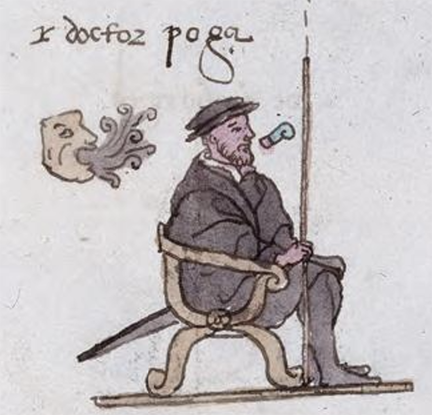
This painted simplex Nahuatl hieroglyph represents the Spanish surname Puga, which is rendered phonetically as smoke (pocatl), creating a disyllabogram poca. The glyph shows the head of a man in profile, facing right, with seven gray curls of smoke emerging from his mouth.
Stephanie Wood
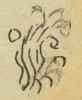
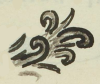
Note how smoke is the visual for both of the names Pocatl and Poctli (below). But here, Pocatl fits better the phonetic representation of Puga. Another attempt at deciphering this name gives: “PURGA, Puga.” [See: Alonso Zamora, Tlacuilolli: A Blog about Mesoamerican Writing Systems, https://tlacuilolli.com/2023/11/27/whats-in-a-name-the-mystery-of-a-glyph-in-codex-osuna/]. I believe pocatl fits better than purga (the Spanish term for purge), which might not even have been known to the Nahuas.
Stephanie Wood
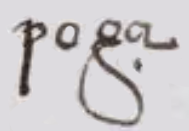
poga
Puga
Stephanie Wood
1551–1565
Jeff Haskett-Wood
humo, voluta, volutas, gris, nombres de hombres, nombres de españoles
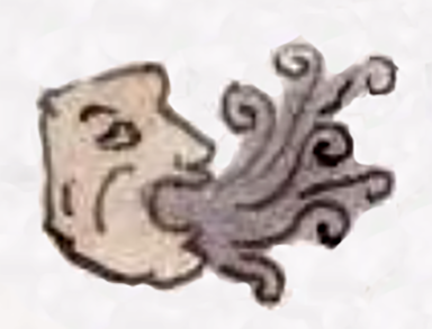
poca(tl), smoke, https://nahuatl.wired-humanities.org/content/pocatl
Library of Congress Online Catalog and the World Digital Library, Osuna Codex, or Painting of the Governor, Mayors, and Rulers of Mexico, https://www.loc.gov/resource/gdcwdl.wdl_07324/. The original is located in the Biblioteca Nacional de España.
"The Library of Congress is unaware of any copyright or other restrictions in the World Digital Library Collection. Absent any such restrictions, these materials are free to use and reuse." But please cite the Biblioteca Nacional de España and this Visual Lexicon of Aztec Hieroglyphs if you use any of these images here or refer to the content on this page, providing the URL.