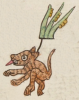
Villanueva (Osu18v)
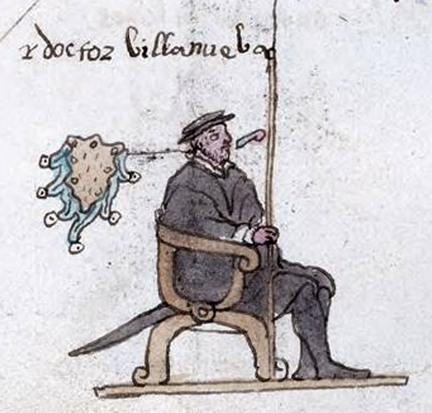
This painted compound Nahuatl hieroglyph represents the Spanish surname Villanueva. It has two elements. One is water (atl), which may provide the -a- syllable at the end of Villa-. The first part of Villa- is not represented visually. The next element is an animal hide (ehuatl), which contributes a disyllabogram -ehua, which covers part of -nueva. The water surrounds the outside of the hide. The water, which is painted a turquoise blue, has lines of current (movement) and six little splashes, each one with a white droplet or bead at the tip. The hide has a few markings that texture it, as though the hair (perhaps of a deer) is still attached. It also has the animal’s neck covering at the bottom and seven holes near the outer edges which may relate to the location of legs and tail, although there are an extra two holes if that is their origin.
Stephanie Wood
This manuscript and a few others have a number of hieroglyphs that represent Spanish surnames (see some other examples below). I concur with the study of this particular compound that was made by: Alonso Zamora, Tlacuilolli: A Blog about Mesoamerican Writing Systems, https://tlacuilolli.com/2023/11/27/whats-in-a-name-the-mystery-of-a-glyph-in-codex-osuna/, although he interprets the -a- from atl as complementary to the final -a- of -ehua, which may well be correct.
Stephanie Wood
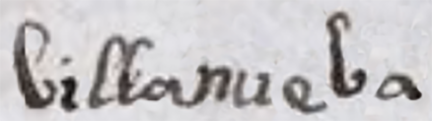
villanueva
Villanueva
Stephanie Wood
1551–1565
Jeff Haskett-Wood
piel de animal, agua, nombres de hombres, nombres de españoles
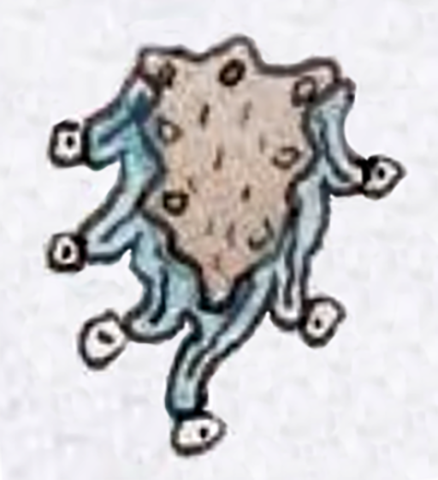
a(tl), water, https://nahuatl.wired-humanities.org/content/atl
ehua(tl), a hide or animal skin, https://nahuatl.wired-humanities.org/content/ehuatl
Library of Congress Online Catalog and the World Digital Library, Osuna Codex, or Painting of the Governor, Mayors, and Rulers of Mexico, https://www.loc.gov/resource/gdcwdl.wdl_07324/. The original is located in the Biblioteca Nacional de España.
"The Library of Congress is unaware of any copyright or other restrictions in the World Digital Library Collection. Absent any such restrictions, these materials are free to use and reuse." But please cite the Biblioteca Nacional de España and this Visual Lexicon of Aztec Hieroglyphs if you use any of these images here or refer to the content on this page, providing the URL.